If you are searching for the best Datto alternative, you are probably not asking whether backup matters. You are asking whether your current backup and disaster recovery provider gives you enough recovery confidence, cost predictability, compliance support, and human help when systems go down.
- Datto SIRIS is a well-known name in business continuity and disaster recovery. Its platform is built for backup, recovery, cloud virtualization, ransomware resilience, and MSP-scale management. For many managed service providers, that broad platform is a good fit.
- Central Data Storage is different. CDS is built for businesses that want managed, verified recovery with private infrastructure, HIPAA-aligned safeguards, flat-rate pricing, and hands-on support from a team that understands regulated data.

Best Datto Alternative: Quick Verdict
Central Data Storage is the better Datto alternative if your organization needs more than a backup platform. It is a better fit when you need a managed recovery partner that helps verify restore points, reduce third-party cloud dependency, support HIPAA-aligned operations, and guide recovery when downtime becomes urgent.
- Choose Datto if you need a broad MSP ecosystem with business continuity appliances, cloud recovery, RMM/PSA integrations, and a large partner platform.
- Choose Central Data Storage if you need managed backup and disaster recovery for healthcare, dental, and regulated environments where clean recovery, support access, and compliance readiness matter as much as the backup software itself.
Datto Backup and Disaster Recovery: What Datto SIRIS Does Well
Datto SIRIS is an established backup and disaster recovery solution. Datto describes SIRIS as an all-in-one BCDR platform that combines hardware, software, and cloud disaster recovery. Its product page emphasizes fast recovery, backup verification, immutable cloud architecture, encryption, ransomware detection, and flexible deployment options.
That makes Datto a strong option for MSPs and IT teams that want a broad, integrated business continuity platform. Datto also has a large ecosystem around remote monitoring, PSA tools, SaaS backup, endpoint backup, and related IT management products through Kaseya.
The main question is not whether Datto can protect data. It can. The better question is whether Datto is the right fit for your organization’s recovery model, compliance needs, pricing expectations, and support preferences.
Why Businesses Look for a Datto Alternative
Businesses usually start looking for a Datto alternative when they want more confidence in recovery outcomes, simpler pricing, less platform complexity, or a more specialized partner.
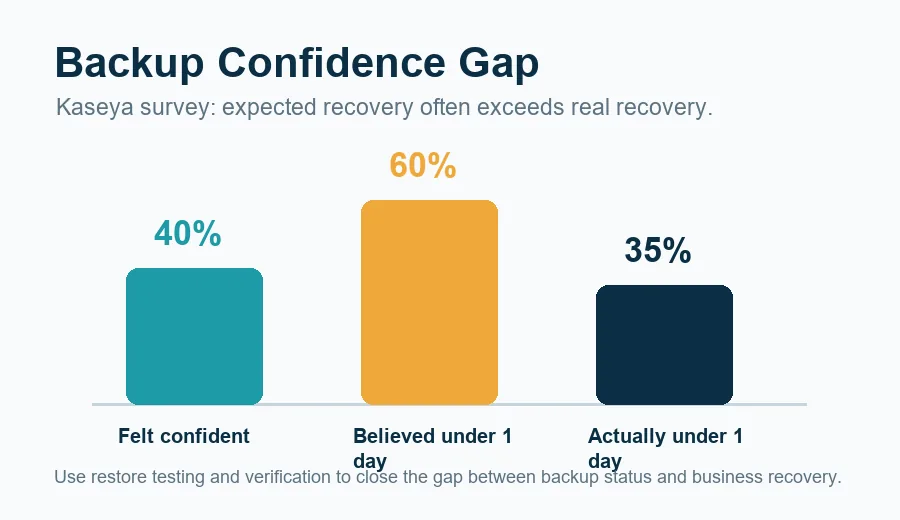
The concern is justified. Kaseya’s 2025 backup and recovery survey found that only 40% of respondents felt confident in their systems. The same report found a gap between expected and real recovery performance: 60% believed they could recover in under a day, but only 35% actually could.
That gap is the real risk. A backup job can complete successfully while the recovery plan still fails because the restore point is corrupted, incomplete, infected, poorly documented, or too slow for the business to tolerate. For healthcare and dental organizations, the stakes are higher. Patient access, billing, imaging, scheduling, claims, and compliance workflows all depend on data availability.
Because of these requirements, healthcare organizations often evaluate backup providers based on more than platform features. Factors such as recovery reliability, operational support, and healthcare-specific protection capabilities play an important role when selecting the right solution. Exploring the best backup services for healthcare providers can help organizations compare available approaches.
HHS explains that the HIPAA Security Rule is designed to protect the confidentiality, integrity, and availability of electronic protected health information. Backup and disaster recovery are not only IT tasks in that environment. They are operational continuity and compliance responsibilities.
Datto vs Central Data Storage: Backup and Disaster Recovery Differences
-
Recovery Verification and Clean Restore Confidence
Datto emphasizes backup verification and recovery features, including screenshot verification and recovery testing options. That is valuable.
Central Data Storage positions recovery verification as the center of the service model. UnisonBDR is built around clean, verified recovery, backup health alerts, corrupted file isolation, pre-storage file scanning, and guided restore assistance. CDS does not treat backup completion as the finish line. The goal is a restore point the business can actually trust.
This matters most during ransomware recovery. If infected or corrupted data enters the backup chain, restoration can reintroduce the same problem. CDS focuses on clean recovery so organizations can restore with more confidence.
-
Private Backup Infrastructure and Third-Party Cloud Exposure
Datto uses the Datto Cloud as part of its BCDR architecture. That can be useful for MSPs that want a broad cloud recovery platform.
CDS emphasizes private infrastructure. The CDS website states that it operates fully owned infrastructure rather than relying on shared third-party clouds. UnisonBDR also states that backups are stored on CDS private infrastructure, not AWS, Azure, or Google Cloud.
For regulated businesses, infrastructure ownership can simplify vendor-risk conversations. It gives buyers a clearer answer to a basic question: who controls the environment where our recovery data lives?
-
HIPAA-Aligned Backup and BAA Readiness
Datto can be part of a compliant environment when configured and managed correctly. But healthcare compliance depends on more than a vendor’s feature list. It depends on policy, access control, encryption, retention, recovery testing, documentation, and business associate responsibilities.
Central Data Storage is more directly positioned for healthcare and dental organizations. UnisonBDR highlights HIPAA-aligned safeguards and BAA availability during onboarding. CDS also has dedicated healthcare, dental, and patient management software positioning across its website.
That makes CDS a stronger fit for organizations that want their backup partner to understand healthcare workflows, protected health information, and recovery expectations.
-
Datto Support Model vs CDS Guided Recovery Support
Datto is built for a large MSP partner ecosystem. That scale can be useful, but some businesses want direct, human support from the team responsible for their backup and recovery environment.
CDS emphasizes U.S.-based, human-first support and guided restore assistance. For smaller healthcare groups, dental practices, and regulated SMBs, that support model can matter as much as the software. During an outage, the business needs someone who can help restore operations, not only point to a portal.
-
BDR Pricing Clarity and Egress-Fee Risk
Datto’s public page emphasizes flat-fee service and no hidden fees for cloud administration, ingress, egress, DR testing, or disaster recovery. Buyers should still validate their exact quote, contract terms, retention model, and recovery assumptions.
Central Data Storage gives a clear value story through UnisonBDR: flat-rate pricing, no egress or retrieval fees, and plans tied to storage tiers. For buyers frustrated by unpredictable cloud backup economics, that simplicity is a major advantage.
The practical takeaway is simple: compare total recovery cost, not only monthly backup cost. Ask what happens when you need to restore a large environment, test disaster recovery, retrieve archived data, or expand retention.
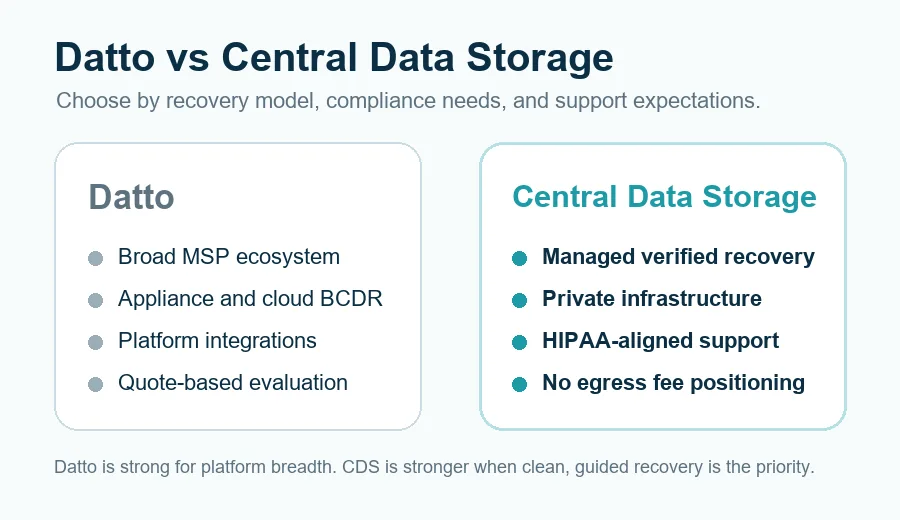
Datto is a broad BDR platform, while CDS emphasizes managed, clean, verified recovery.
Best Datto Alternative for Healthcare and Dental Practices
For healthcare and dental practices, the best Datto alternative is not necessarily the vendor with the longest feature list. It is the vendor that can help keep patient data available, recoverable, and protected through real operational disruption.
Dental practices depend on practice management software, imaging systems, billing data, claims information, patient communications, and local workstations. A generic file backup may not fully protect that workflow. Recovery planning needs to account for databases, image folders, open files, retention, restore timing, and application dependencies.
Central Data Storage is a strong Datto alternative for this use case because CDS is already positioned around HIPAA-compliant backup, backup verification, data recovery, and disaster recovery. The value is not only that CDS stores backup copies. The value is that CDS helps practices build a recovery path around the systems they use to serve patients.
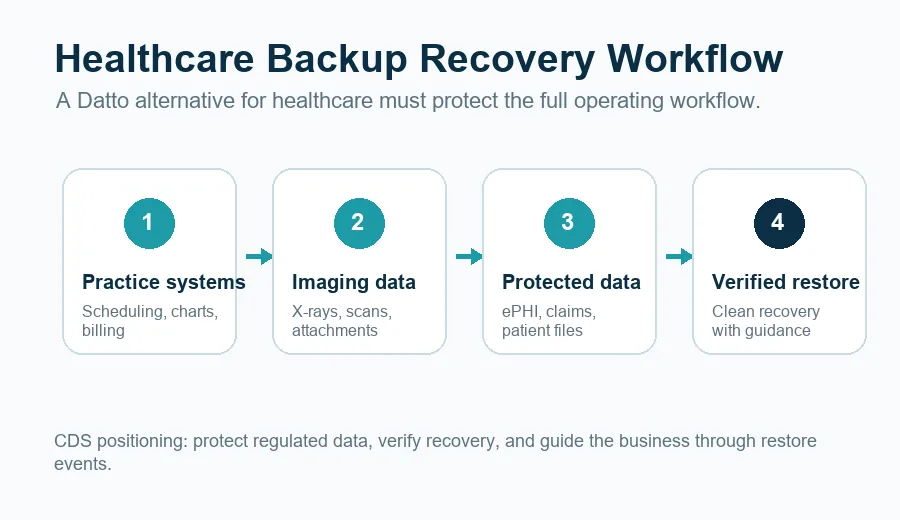
Healthcare and dental recovery planning must protect databases, images, billing, scheduling, and patient access.
Datto vs Central Data Storage Comparison Summary
Datto is strong when the buyer wants a broad BCDR platform with an established MSP ecosystem, appliance and cloud recovery options, ransomware-focused features, and integration with other IT management tools.
Central Data Storage is stronger when the buyer wants a specialized managed backup and disaster recovery partner focused on clean recovery, healthcare and dental readiness, private infrastructure, predictable pricing, and human support.
Use this decision rule:
- Choose Datto if your priority is a large MSP platform and broad IT management ecosystem.
- Choose Central Data Storage if your priority is verified recovery, HIPAA-aligned support, private infrastructure, and a more guided backup relationship.
How to Evaluate Any Datto Alternative Before You Switch
Before switching from Datto or choosing a Datto alternative, ask these questions:
- Does the provider verify that backups are recoverable, or only report that backup jobs completed?
- Can the provider show how corrupted or infected files are handled before restore?
- Where is the backup data stored, and who controls that infrastructure?
- Are there egress, retrieval, disaster recovery testing, or cloud administration fees?
- Does the provider support your actual applications, databases, imaging files, and open files?
- Is a Business Associate Agreement available if you handle ePHI?
- How often are restores tested?
- What happens during a ransomware event?
- Who helps during recovery, and how quickly can you reach them?
IBM’s 2025 Cost of a Data Breach Report lists the global average breach cost at $4.4 million and recommends regularly testing incident response plans and backups. That is the standard buyers should use. A backup strategy is not mature until restore testing proves the business can recover.
Final Recommendation: Should You Choose Datto or Central Data Storage?
Datto is a capable BDR platform. It is a reasonable choice for MSP-led environments that want a broad business continuity and IT management ecosystem.
Central Data Storage is the stronger choice for healthcare, dental, and regulated businesses that want managed backup and disaster recovery with clean recovery verification, private infrastructure, flat-rate pricing, and direct support.
If your main concern is whether you can recover cleanly when patient operations, revenue, compliance, and trust are on the line, Central Data Storage is the Datto alternative worth evaluating first.
FAQs About Best Datto Alternatives
Is Central Data Storage a Datto alternative?
Yes. Central Data Storage is a Datto alternative for businesses that need managed backup and disaster recovery, especially healthcare, dental, and regulated organizations that want verified recovery, private infrastructure, and hands-on support.
What makes CDS different from Datto?
CDS is more specialized around managed recovery, healthcare and dental data protection, private infrastructure, clean restore verification, and flat-rate pricing. Datto is broader and more MSP-platform oriented.
Is Datto still a good BDR solution?
Yes. Datto SIRIS remains a recognized backup and disaster recovery platform with appliance, cloud, verification, ransomware, and business continuity features. The question is whether its model fits your organization’s support, compliance, infrastructure, and pricing needs.
What is the best Datto alternative for dental practices?
Central Data Storage is a strong Datto alternative for dental practices because it understands healthcare backup needs, patient data availability, imaging and practice-management workflows, HIPAA-aligned safeguards, and recovery support.
Why does backup verification matter?
Backup verification helps confirm whether backup data can actually be restored. Without verification, a business may not discover corruption, missing files, infection, or restore delays until an outage or ransomware incident is already underway.

![10 Best Backup Services for Healthcare Providers [2026 Comparison]](https://centraldatastorage.com/wp-content/uploads/2026/08/Backup-Services-for-Healthcare-Providers-400x250.png)