If your IT team successfully removes ransomware, but your critical files, applications, or systems are still unavailable, has your organization actually recovered?
Removing the malicious software is only one part of responding to a ransomware attack. The disruption can continue after the immediate threat is addressed.
A 2026 study in the American Economic Journal: Economic Policy that linked hospital ransomware incidents with Medicare claims data found that hospital volume fell by 17%–24% during the initial week of an attack and recovered within about three weeks (Source).
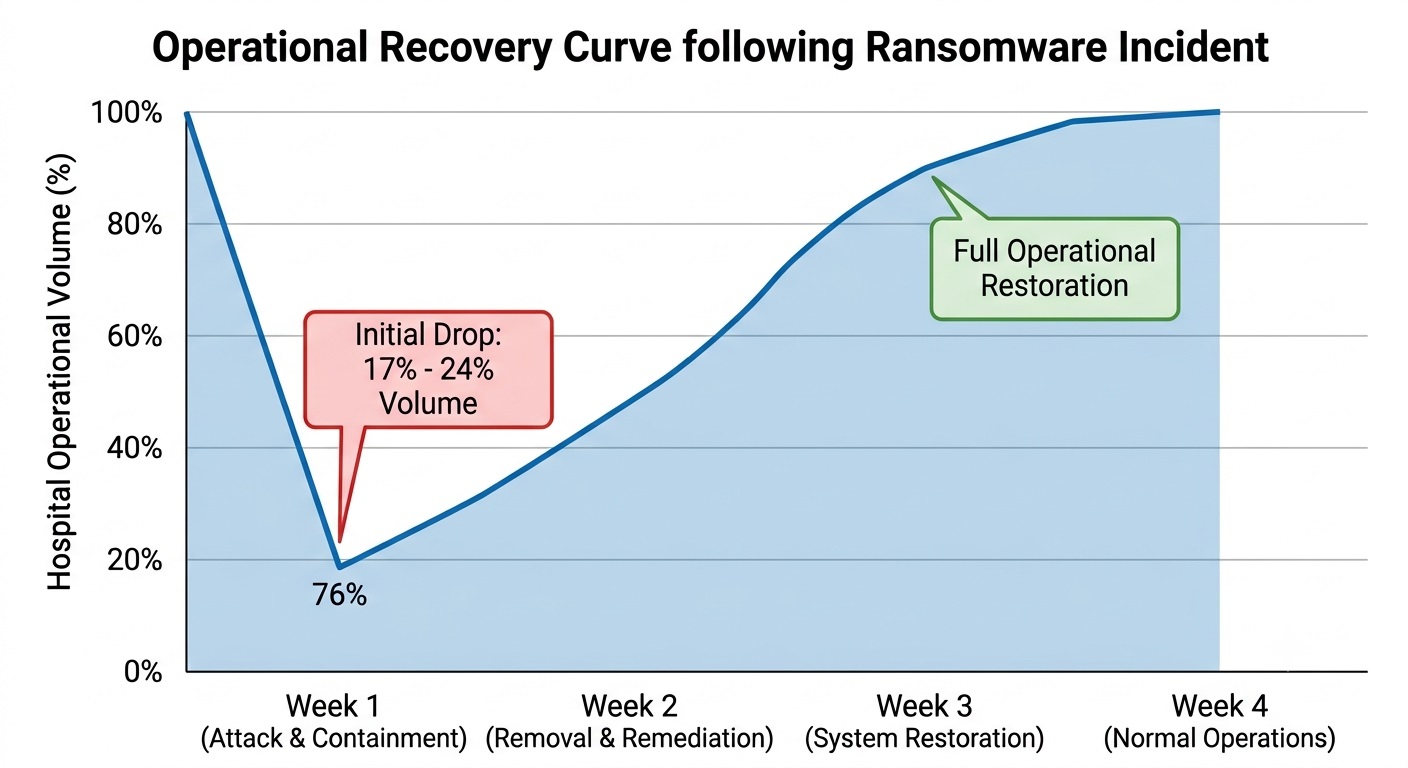
That distinction is important when discussing ransomware removal vs. recovery. Ransomware removal focuses on eliminating the malicious software, while ransomware recovery focuses on restoring affected data, applications, systems, and operational access. Removing ransomware does not automatically decrypt files or return an organization to normal operations.
Quick Answer: Is Ransomware Removal the Same as Ransomware Recovery?No. Ransomware removal eliminates the malicious software, while ransomware recovery restores the data, applications, and systems affected by the attack. Even after ransomware is removed, encrypted or unavailable data may still require restoration from an appropriate recovery point. |
What is Ransomware Removal and What Does it Actually Fix?
Ransomware removal is the process of identifying and eliminating malicious ransomware components from affected systems as part of the broader incident response. In many incident-response frameworks, ransomware removal is treated as part of eradication: eliminating malicious software and addressing persistence mechanisms or other conditions that could allow the compromise to continue or recur.
Containment actions, such as isolating affected systems, are typically taken to limit further spread or damage. Removing the ransomware does not necessarily reverse the effects it has already had on data and systems (Source).
What Happens When You Remove Ransomware?
Depending on the incident, responding to ransomware may involve isolating affected systems to limit further activity, identifying malicious files or processes, removing the ransomware, and addressing mechanisms that could allow malicious activity to persist or recur.
Containment and eradication are related but distinct activities. Containment limits the spread or impact of the incident, while eradication addresses the malicious software, persistence mechanisms, compromised accounts, and exploited entry points associated with the incident. CISA recommends identifying affected systems and immediately isolating them as an early ransomware-response action (Source).
Ransomware removal should therefore not be treated as proof that affected data and systems are ready to return to normal use.
What Ransomware Removal Does Not Restore
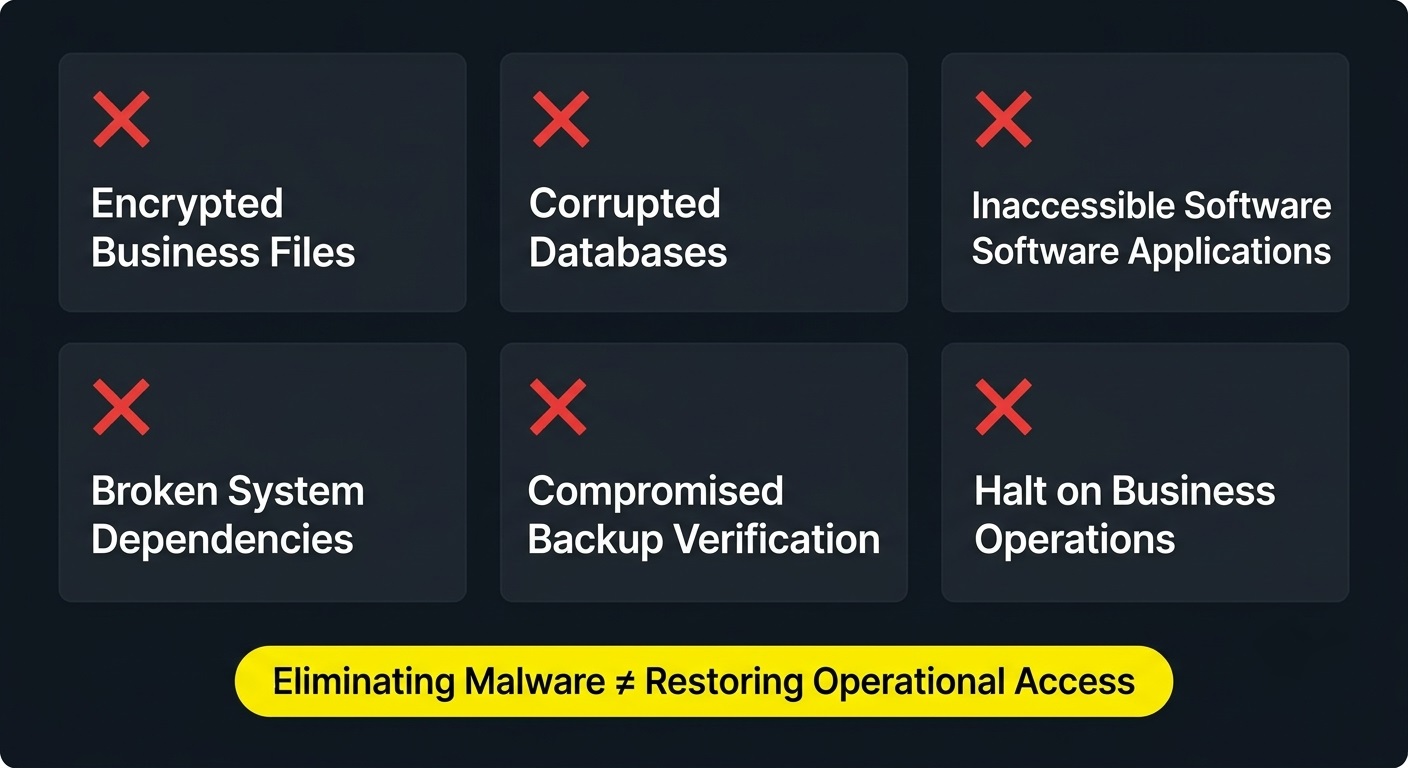
Even after an organization removes active ransomware components, consequences of the broader incident may remain. Removal does not automatically:
- Decrypt files that have already been encrypted
- Restore deleted, corrupted, or inaccessible business data
- Recover affected databases or applications
- Restore systems and their dependencies
- Establish that an available backup is appropriate for restoration
- Return disrupted business operations to normal
For example, ransomware could be removed from a server while the database used by a medical practice remains encrypted or inaccessible. The malicious software may no longer be operating, but the organization still has a data and operational recovery problem to solve.
This is the key distinction between ransomware removal and ransomware recovery: removing malicious ransomware components addresses one part of the incident response, while recovery addresses the data, systems, and operations affected by the incident.
What is Ransomware Recovery After an Attack?
Ransomware recovery is the process of restoring data, applications, systems, and other affected IT resources following a ransomware attack so the organization can resume critical operations. Recovery can involve much more than retrieving encrypted files because the attack may also affect databases, applications, system configurations, and the infrastructure needed to use that data.
What Data, Applications, and Systems Need Recovery?
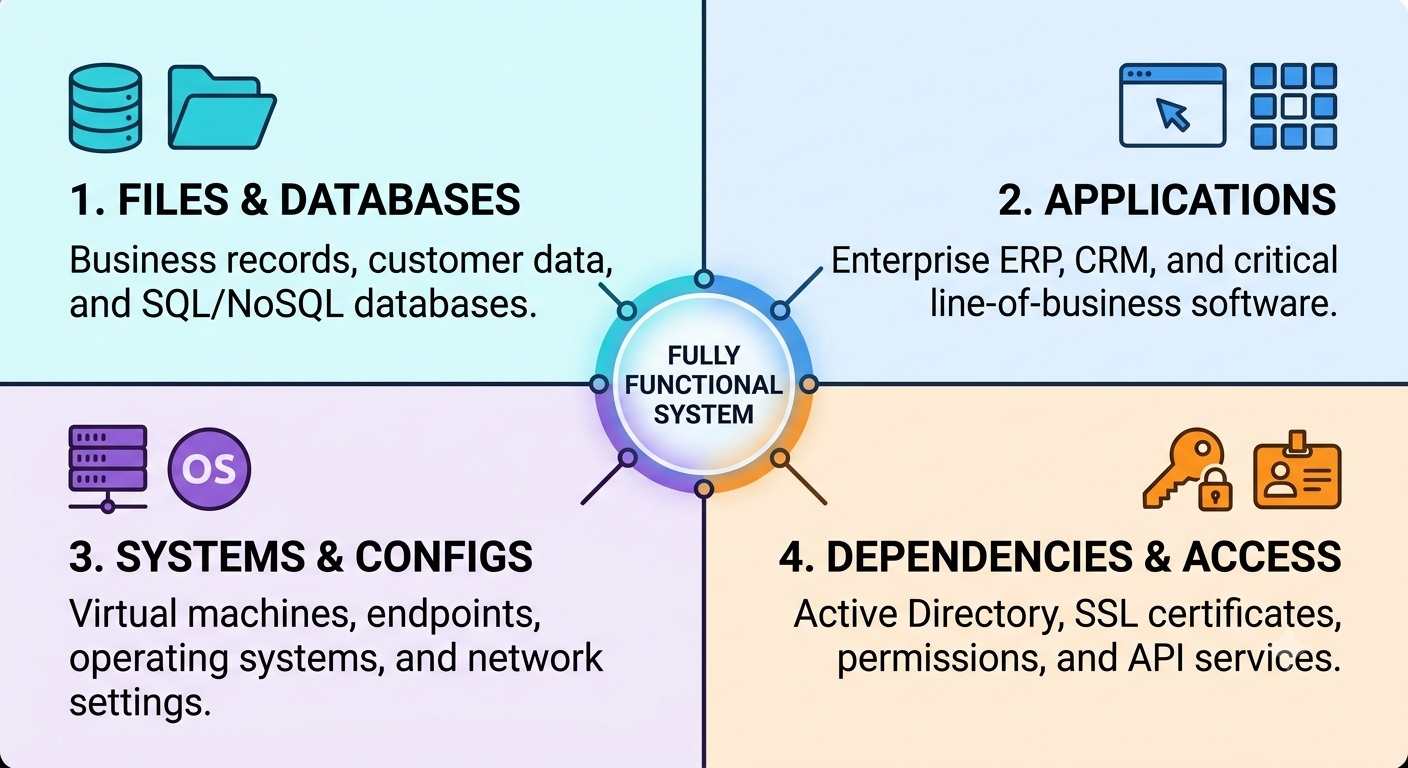
The scope of recovery depends on what the incident affected and which services the organization needs to restore first. Recovery may include:
- Files and databases: Business records, documents, databases, and other information that was encrypted, corrupted, deleted, or made inaccessible.
- Applications: Software required to access, process, and use recovered information.
- Systems and configurations: Servers, endpoints, operating systems, configurations, and other technology required to support critical applications.
- Supporting dependencies and access: Authentication, permissions, connected services, and other dependencies required for restored systems to function as intended.
For example, restoring a healthcare database does not necessarily restore the workflow that depends on it if the associated application, authentication service, or supporting system remains unavailable.
When is Ransomware Recovery Successful?
The goal is not simply to recover the largest possible number of files. Organizations need to restore the data and systems required for critical services while establishing confidence in the integrity and usability of what has been recovered.
In practical terms, successful recovery moves the organization toward an outcome where required data is accessible, necessary applications and systems function as intended, restored resources have been validated, and critical operations can resume.
Ransomware Removal vs. Recovery: What’s the Difference?
The key difference between ransomware removal and recovery is their objective. Removal addresses the ransomware itself, while recovery addresses the disruption and loss of access caused by the incident.
An organization can therefore remove ransomware successfully and still have critical data, applications, or systems that require recovery.
Ransomware Removal vs. Recovery Comparison
The table below shows how ransomware removal and recovery differ in their objectives, scope, and outcomes during a ransomware incident.
| Comparison point | Ransomware Removal | Ransomware Recovery |
| Primary objective | Eliminate malicious ransomware components and address activity or persistence associated with the incident | Restore resources affected by the ransomware incident |
| Problem addressed | Active or persistent malicious software | Unavailable data, disrupted systems, and loss of operational access |
| What it acts on | Malicious files, processes, persistence mechanisms, and affected systems | Files, databases, applications, operating systems, configurations, and supporting resources |
| Typical activities | Isolating affected systems, identifying malicious components, eliminating the ransomware, and addressing persistence | Prioritizing affected resources, selecting an appropriate recovery source, restoring resources, and validating the result |
| Effect on encrypted files | Removing ransomware does not automatically decrypt files | Encrypted data may be restored from an appropriate backup or recovered through another viable method |
| Effect on deleted or corrupted data | Removal alone does not restore it | Data may be restored if an appropriate recovery source is available |
| Role of backups | Not necessarily required for malware removal | Can provide the data or system state needed for restoration |
| Role of restore points | Not a primary removal concern | An appropriate recovery point must be identified before restoration |
| Applications and systems | Removing the malware does not automatically return affected applications or systems to service | Applications, systems, configurations, and necessary dependencies may need restoration |
| Validation | Determines whether malicious activity has been adequately addressed | Determines whether restored resources are usable and suitable for returning to operation |
| Relationship to remediation | Can be one component of broader ransomware remediation | May occur alongside remediation as affected resources are restored |
| Success criterion | Malicious ransomware components, persistence mechanisms, and relevant pathways for continued compromise have been addressed and validated to an appropriate level of confidence | Required data and systems are restored to a usable, appropriately trusted state |
| Business outcome | Eliminating the malware reduces the immediate threat, but disruption may remain | Restoring required resources supports the resumption of critical operations |
The distinction becomes especially important when ransomware has already encrypted or disrupted business data. Eliminating the malware does not reverse those effects. Recovery must address what the attack left behind.
Why Are Files Still Encrypted After Ransomware Removal?
Removing ransomware does not necessarily undo changes the malware made before it was eliminated. Depending on the attack, data may remain encrypted, deleted, altered, or otherwise inaccessible and require a separate recovery process.
Does Removing Ransomware Decrypt Files?
When ransomware encrypts a file, it prevents normal access to the data through encryption. Removing the ransomware program does not, by itself, decrypt files that have already been encrypted.
Whether encrypted data can be recovered depends on the circumstances of the incident and the recovery options available. An organization may be able to restore data from an appropriate backup or, for some ransomware variants, use a legitimate decryption tool.
A legitimate decryptor is available only for some ransomware variants or incidents, so organizations should not assume that encrypted data can be decrypted simply because the malware has been removed. Recovery teams should consult trusted incident-response resources and law-enforcement guidance when determining whether a legitimate decryptor is available.
Why Systems and Applications May Still Need Recovery
The effects of a ransomware incident can extend beyond individual files. Databases may be unavailable, applications may depend on affected data or configurations, and systems supporting critical services may require restoration.
For example, a medical practice might remove ransomware from an affected server but still be unable to use its practice-management application if the underlying database or another required resource remains inaccessible.
The organization therefore needs to identify which data, applications, and systems remain affected and which are most critical to restore. That assessment determines the recovery process’s scope and priorities.
What Should You Do After Ransomware Removal?
Once the malicious software has been addressed, attention shifts to determining the extent of the remaining disruption and restoring the resources the organization needs most. Recovery priorities will vary by incident, so the process should be based on the affected systems, business dependencies, and available recovery options.
A practical progression is:
Assess Impact → Identify an Appropriate Recovery Point → Restore → Validate → Return to Use
1. Assess Affected Data, Applications, and Systems
Start by identifying what remains unavailable or unusable and how those resources support critical operations. This may include:
- Business-critical files and databases
- Applications and their supporting services
- Servers, operating systems, and configurations
- Authentication or other system dependencies
- Connections between affected systems
Recovery priorities should reflect business impact and dependencies rather than simply restoring everything at once. For example, restoring an application before the database or authentication service it depends on may not return that application to usable operation.
2. Identify an Appropriate Ransomware Recovery Point
The next step is determining what state the affected data or system should be restored from. Depending on the organization’s recovery capabilities, potential sources may include protected backup copies, snapshots, or other known-good recovery points.
The most recent copy is not automatically the appropriate choice. A recovery point should be assessed in the context of when the compromise or destructive activity may have occurred, whether it contains the required data, and whether it is suitable for restoration and validation.
This distinction is particularly important with ransomware because the existence of a backup answers only one question: “Do we have a copy?” Recovery also requires answering: “Is this the right copy to restore?”
3. Restore and Validate Critical Data and Systems
After an appropriate recovery point has been selected, affected resources can be restored according to their recovery priority and dependencies.
Restoration should then be validated before recovered resources are relied upon for normal operations. Depending on the systems involved, validation may include confirming data accessibility and completeness, application functionality, dependency availability, security monitoring, and business-process usability.
In other words, a completed restore operation is not by itself proof of successful recovery. The restored resources must also function as intended before they can reliably support critical operations.
Ransomware Removal vs. Remediation vs. Recovery
Ransomware remediation is a broader term for actions taken to address security weaknesses, threats, or conditions associated with the incident. Depending on how an organization or provider uses the term, remediation can overlap with ransomware removal, eradication, and recovery rather than functioning as a completely separate phase.
For this reason, it is useful to distinguish the three concepts by their primary focus:
| Process | Primary focus | Intended outcome |
| Ransomware removal | Malicious ransomware components and activity | Eliminate malicious ransomware components and address associated activity or persistence |
| Ransomware remediation | Security weaknesses and conditions associated with the compromise | Correct or mitigate issues that could allow the threat to persist or recur |
| Ransomware recovery | Data, applications, systems, and services affected by the incident | Restore required resources to a usable, appropriately trusted state |
Remediation may include addressing persistence mechanisms, compromised accounts, exploited vulnerabilities, or affected configurations.
NIST incident-response guidance similarly describes eradication as eliminating persistence and entry points while identifying and mitigating exploited vulnerabilities (Source).
Remediation and recovery can also happen in parallel. For example, systems may be restored while security teams continue correcting weaknesses associated with the incident.
The important distinction is that restoring business data does not by itself remediate the security conditions that contributed to the incident, just as remediation does not automatically restore data or systems affected by the attack.
Why a Validated Recovery Point Matters After Ransomware
A backup gives an organization a potential source for restoration, but its existence does not establish that it is the appropriate recovery point after a ransomware incident. Recovery teams need to evaluate whether the copy contains the required data, predates relevant compromise or destructive activity where possible, and is suitable for restoration and validation.
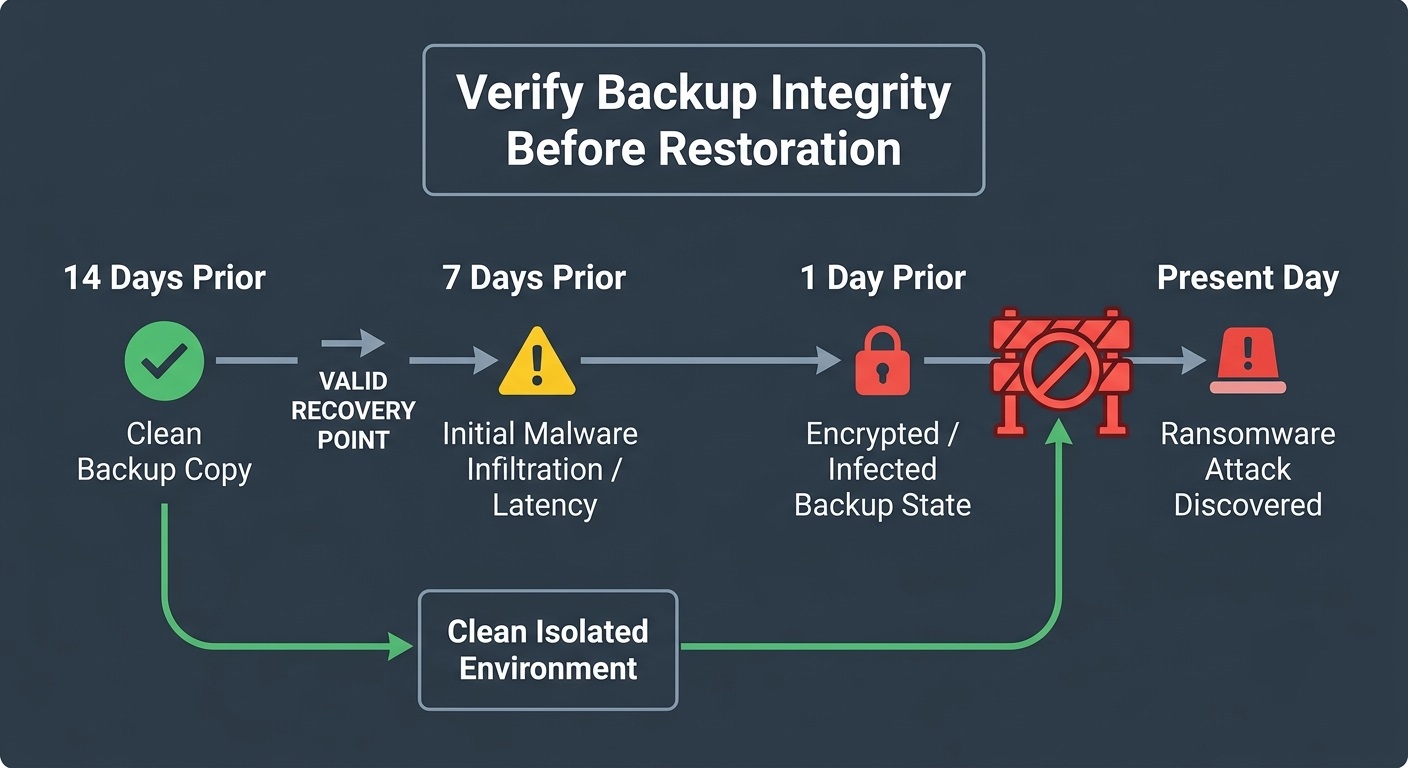
This matters because ransomware incidents can affect more than production systems, including accessible backup and recovery resources.
Can Ransomware Affect Backups and Restore Points?
Attackers may attempt to encrypt, delete, or otherwise disrupt accessible backup and recovery resources to make restoration more difficult. CISA recommends maintaining offline, encrypted backups of critical data and regularly testing their availability and integrity in a disaster-recovery scenario (Source).
This means recovery should not be based solely on choosing the newest available copy. The organization needs an appropriate recovery point that contains the required data and is suitable for restoration. Understanding the difference between clean and infected restore points can help explain why the newest backup is not automatically the right one to use.
How Should Recovery Copies Be Evaluated Before Restoration?
Before relying on a recovery copy, organizations should establish confidence that the data being restored has the required integrity. Ransomware recovery requires processes to assess whether recovered data is accurate, complete, and sufficiently trusted for use, including appropriate validation and security checks before restored resources return to production.
In practical terms, this means considering whether:
- The recovery point predates the relevant compromise or destructive activity where possible.
- The required business data is present.
- The backup or recovery copy has maintained its integrity.
- Restored resources can be validated before returning them to use.
This is why backup availability and recovery readiness are not the same thing. Regular backup restore testing can provide evidence that protected data can actually be recovered when needed.
For organizations that need deeper assurance around restore-point integrity, CDS uses backup verification and clean recovery as part of its broader approach to verified restoration.
When is Ransomware Recovery Complete?
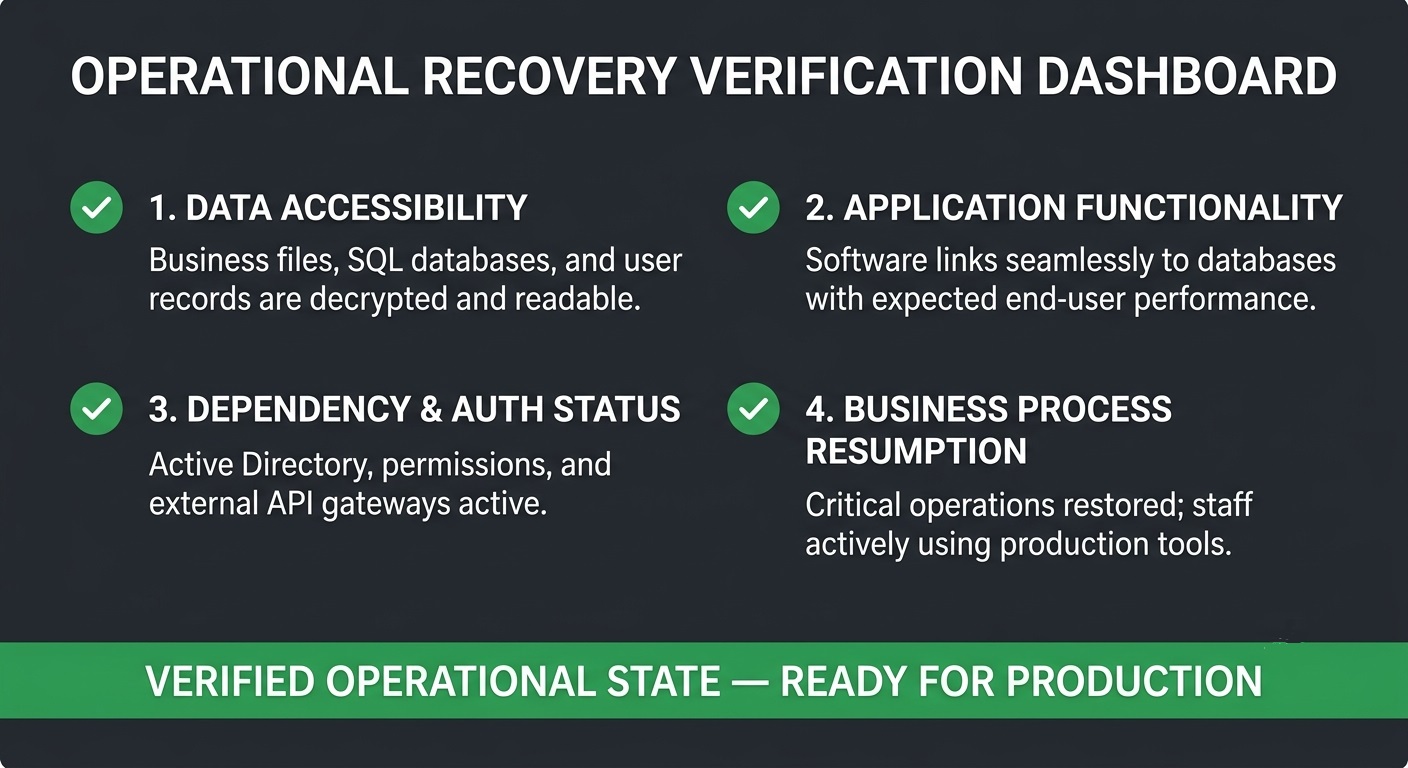
Successful ransomware recovery is not defined simply by whether a restore job finishes. The more meaningful measure is whether the organization can safely use the restored resources to resume the critical operations affected by the incident.
A successful recovery should establish that:
- Required data is accessible: Critical files, databases, and records needed for operations can be accessed and used.
- Applications function as expected: Applications can connect to their required data and perform the functions needed by users.
- System dependencies are available: Authentication, configurations, connected services, and other dependencies required by restored systems are functioning.
- Restored resources have been validated: Recovery results have been checked for integrity and appropriate operation before being relied upon.
- Critical operations can resume: The organization can return affected business processes to service according to its recovery priorities.
For a healthcare organization, for example, recovery is more meaningful when staff can once again access the systems and data required for patient care, not merely when a server or backup reports a successful restore.
The practical endpoint is therefore operational recovery: trusted data, functioning systems, and the ability to resume the critical services that depend on them.
Conclusion: Removed Ransomware but Still Need Your Data Back?
Removing the ransomware does not necessarily restore the data and systems affected by the incident. If critical resources remain unavailable, the next challenge is determining which recovery point is appropriate and restoring the resources the organization needs to resume operations.
Central Data Storage (CDS) focuses on this recovery challenge. Our Ransomware Recovery Services are designed to help organizations evaluate available recovery points, prioritize restoration based on operational dependencies, and validate restored resources before they return to normal use.
The CDS recovery process includes:
- Reviewing available backup history to identify potential restore points
- Evaluating restore readiness and backup integrity
- Prioritizing critical data, applications, databases, and systems based on operational dependencies
- Restoring priority resources through a controlled recovery process
- Validating recovered data and required dependencies before normal production use resumes
The objective is not simply to restore data quickly. It is to restore the required data and systems from an appropriate recovery point, validate their integrity and functionality, and confirm that the recovered environment is suitable before returning it to normal operation.
Get Help With Ransomware Recovery
If ransomware has affected your data or systems, CDS Ransomware Recovery Services can help you evaluate your recovery options and move through a structured, verified restoration process.
Want to understand your recovery readiness before an incident? Request a Data Risk & Recovery Assessment to evaluate whether existing backups are suitable for recovery and to identify potential backup-integrity issues, recovery-chain weaknesses, threats in stored data, and gaps in the recovery architecture.
FAQs About Ransomware Removal and Recovery
Can Ransomware be Completely Removed?
Ransomware can often be eliminated from affected systems, but removal alone does not restore encrypted or damaged data. Organizations should also address persistence mechanisms, compromised accounts, exploited vulnerabilities, and other conditions associated with the compromise. Affected systems should be validated before being returned to normal use.
Can Ransomware Come Back After Removal?
Yes. Ransomware or related malicious activity can recur if persistence mechanisms, compromised credentials, exploited vulnerabilities, or other security weaknesses remain. Removal should therefore be accompanied by appropriate eradication, remediation, and validation activities.
Can Encrypted Files be Recovered After Ransomware is Removed?
Potentially. Recovery may be possible using an appropriate backup or, for some ransomware variants, a legitimate decryption tool. Removing the ransomware itself does not decrypt files that were already encrypted.
Should Ransomware be Removed before Restoring a Backup?
Affected systems should be contained, and the environment receiving restored data should be appropriately secured and validated before it returns to production use. In many incidents, organizations restore into rebuilt or otherwise trusted systems rather than relying on the previously compromised environment. Incident response and recovery activities can overlap, so organizations should follow a coordinated recovery plan rather than assume a universal sequence.
How Long Can Ransomware Recovery Take?
Recovery time varies with the attack’s scope, affected systems, recovery-point availability, system dependencies, and validation requirements. Recovery may take days or weeks in complex incidents; removing the malware does not determine when operational recovery is complete.
References
- NIST: Recovering from Ransomware and Other Destructive Events
- American Economic Journal: Effects of Ransomware Attacks on Hospitals & Patients
- CISA: StopRansomware Guide