- How quickly must critical systems return?
- How much recent data can the organization afford to lose?
Recovery Time Objective (RTO) answers the first question. Recovery Point Objective (RPO) answers the second.
These two disaster recovery metrics help organizations define recovery priorities before an incident happens. They influence backup frequency, replication, recovery infrastructure, restore sequencing, and the way recovery readiness is tested.
For healthcare organizations, the stakes are especially high. System downtime can affect access to electronic health records (EHR), patient management systems, imaging platforms, scheduling, billing, and other applications that support clinical and administrative workflows.
Quick Answer: What is the Difference Between RTO and RPO?
- Recovery Time Objective (RTO) defines how quickly a system, application, or service must be restored after a disruption. It represents the maximum acceptable recovery time before downtime causes unacceptable operational impact.
- Recovery Point Objective (RPO) defines the point in time to which data must be recovered. In practical terms, it determines how much recent data loss an organization is prepared to tolerate.
NIST defines RPO as the point in time to which data must be recovered after an outage and RTO as the length of time a system can remain in recovery before the organization’s mission or business processes are negatively affected. (NIST Computer Security Resource Center)
Put simply:
- RTO measures downtime: How quickly must the system come back?
- RPO measures data loss: How recent must the recovered data be?
A recovery strategy needs both. Fast restoration with outdated data can still fail the business, while recent backups are not enough if restoring them takes longer than operations can tolerate.
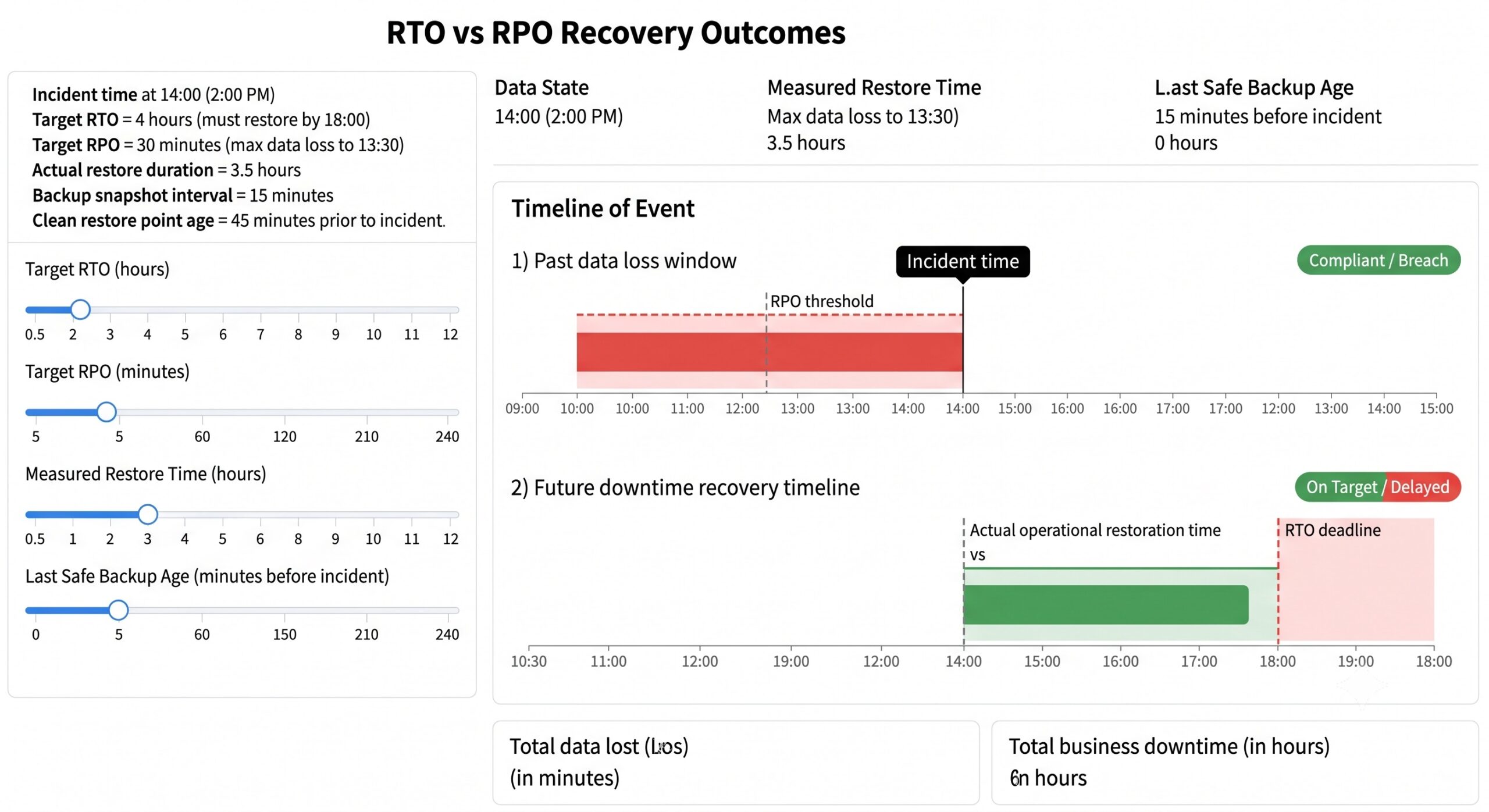
Understanding the distinct timelines of RPO (data loss window) and RTO (downtime restoration window).
What is Recovery Time Objective (RTO)?
Recovery Time Objective is the maximum acceptable amount of time a system, application, or service can remain unavailable following a disruption.
RTO answers:
How quickly must this workload be operational again?
Suppose a healthcare organization defines an RTO of four hours for its patient management system. Its disaster recovery process must be capable of returning that system to usable operation within four hours of the disruptive event.
Missing that objective could affect access to patient information, appointment workflows, billing, staff productivity, and other dependent operations.
A shorter RTO generally requires a faster and more prepared recovery process. Depending on the workload, that may involve local recovery capacity, standby infrastructure, automation, replication, preconfigured environments, or clearly documented recovery sequencing.
What Factors Determine RTO?
RTO should be based primarily on the business impact of downtime.
Important factors include:
- System criticality: How important is the application to clinical or business operations?
- Downtime impact: What happens after 30 minutes, four hours, one day, or longer without the system?
- Dependencies: Which databases, identity services, networks, interfaces, or third-party systems must also be available?
- Manual workarounds: Can operations continue temporarily without the application?
- Recovery architecture: How quickly can infrastructure and applications actually be restored?
- Recovery process: Are responsibilities, sequencing, and escalation paths documented?
- Testing results: Has the organization demonstrated that restoration can finish within the target?
RTO should therefore be treated as an operational requirement rather than a promise made by backup software.
What is Recovery Point Objective (RPO)?
Recovery Point Objective defines how far back in time an organization can tolerate recovering its data after an incident.
RPO answers:
How much recent data can we afford to lose?
Consider an organization with an RPO of 30 minutes. Its recovery strategy must provide an appropriate recovery point no more than 30 minutes older than the incident.
If the only usable backup is six hours old, the recovery may technically succeed while still failing the RPO.
A shorter RPO usually requires data protection to occur more frequently through technologies such as snapshots, replication, continuous data protection, or shorter backup intervals.
What Factors Determine RPO?
Important factors include:
- Data criticality: What would happen if recent records or transactions disappeared?
- Rate of change: How frequently does the system create or modify data?
- Ability to recreate data: Could staff reconstruct missing transactions, patient updates, documents, or configuration changes?
- Operational impact: What is the consequence of restoring an older version of the system?
- Protection frequency: How often are usable recovery points created?
- Recovery-point integrity: Are those recovery points complete and trustworthy?
Backup frequency is therefore related to RPO, but the terms are not identical.
An RPO is a business requirement. Backup, snapshot, and replication frequency are technical methods used to support that requirement.
RTO vs RPO Comparison Table
| Comparison | RTO | RPO |
|---|---|---|
| Full name | Recovery Time Objective | Recovery Point Objective |
| Primary question | How quickly must the system return? | How much recent data can be lost? |
| Measures | Acceptable recovery time/downtime | Acceptable data-loss window |
| Primary focus | System and application availability | Recency of recoverable data |
| Drives | Restore speed and recovery architecture | Backup, snapshot, and replication frequency |
| Influenced by | Infrastructure, dependencies, automation, recovery procedures | Data change rate, protection cadence, replication and recovery-point availability |
| Failure means | The organization remains offline longer than planned | More data is lost than operations can tolerate |
RTO and RPO Example During a Disaster Recovery Event
Assume ransomware takes a patient management system offline at 2:00 p.m.
The organization has:
- RTO: 4 hours
The system should be operational again by 6:00 p.m.
- RPO: 30 minutes
The recovered data should come from approximately 1:30 p.m. or later, assuming that point is safe and usable.
These objectives describe two different dimensions of the same recovery event.
- The RTO determines the required speed of restoration.
- The RPO determines how recent the restored data needs to be.
Should RPO Be Lower Than RTO?
No. RTO and RPO measure different recovery requirements, so neither metric inherently needs to be lower than the other.
An organization could have:
- RTO: 1 hour
RPO: 4 hours
This means the application must return quickly, but restoring data that is several hours old may be operationally acceptable.
Another workload might have:
- RTO: 8 hours
- RPO: 15 minutes
In this case, recent data is extremely important even though restoring the application can take longer.
RTO and RPO should therefore be established independently according to the consequences of downtime and data loss.
How to Determine RTO and RPO for Disaster Recovery
Organizations should not start by asking what RTO or RPO their backup product offers.
They should start with the business.
The practical sequence is:
Business impact → downtime tolerance → data-loss tolerance → recovery design → testing
1. Perform a Business Impact Analysis
A Business Impact Analysis (BIA) identifies the systems, data, and processes whose disruption would create the greatest operational consequences.
A broader business impact analysis can help determine which workloads support critical operations and therefore require tighter recovery objectives.
For each system, determine:
- Which business or clinical process depends on it?
- Who cannot perform their work if it becomes unavailable?
- Does the impact increase as downtime continues?
- Would unavailable or missing data affect patient care?
- Would the outage interrupt revenue-generating activity?
- Are there compliance or contractual consequences?
- What other systems depend on this workload?
Healthcare organizations should perform this analysis at the workload level rather than treating the entire environment as equally critical.
An EHR, PACS environment, billing platform, scheduling system, archive, and internal file server may all have different operational consequences when unavailable.
2. Define Maximum Acceptable Downtime for Each System
Once the operational impact is understood, determine how long each system can realistically remain unavailable.
That tolerance informs the RTO.
A system supporting time-sensitive clinical workflows may require a much shorter RTO than an archival system that staff rarely access during normal operations.
This exercise should also identify whether manual workarounds exist and how long they remain practical.
For example, staff may be able to continue limited operations on paper temporarily, but that does not necessarily mean an eight-hour or two-day outage is acceptable. Recovery requirements should reflect how the impact changes as the incident continues.
How RTO Relates to MTPD and Maximum Tolerable Downtime
RTO is sometimes discussed alongside Maximum Tolerable Period of Disruption (MTPD) or Maximum Tolerable Downtime (MTD).
MTPD/MTD represents the outer point beyond which continued disruption becomes unacceptable to the organization.
RTO is the planned target for restoring the system and should be established within that broader tolerance.
3. Define the Maximum Acceptable Data Loss
Next, determine how much recent data could disappear without creating unacceptable consequences.
Ask:
- How frequently does the workload change?
- How many transactions occur during a typical hour?
- Could users reconstruct missing information?
- Would lost patient documentation be difficult or impossible to recreate accurately?
- Would missing billing or scheduling changes create downstream problems?
- What is the oldest acceptable recovery point after an incident?
That tolerance becomes the RPO.
A workload receiving thousands of changes throughout the day will often need a different RPO from an archive that changes infrequently.
The objective should determine the protection cadence – not the other way around.
4. Match Recovery Architecture to RTO and RPO Targets
Once RTO and RPO are known, IT can determine what type of recovery architecture is required.
A shorter RTO may require:
- Fast local restore capability
- Preconfigured recovery infrastructure
- Standby environments
- Recovery orchestration
- Faster storage
- Documented recovery sequencing
- Sufficient network bandwidth
A shorter RPO may require:
- More frequent backups
- Snapshots
- Continuous or near-continuous replication
- Continuous data protection
- Additional recovery-point retention
Ransomware resilience introduces another consideration: whether recovery data remains available when production systems or backup infrastructure are attacked.
Immutable backups can help protect recovery copies from deletion or modification during a defined retention period. Immutability, however, does not establish that the contents of a backup are clean or operationally usable.
The target remains a business requirement. The architecture must demonstrate that it can meet it.
5. Validate RTO and RPO With Recovery Testing
An RTO written in a disaster recovery plan is not the same as a proven recovery time.
Testing should determine how long the actual recovery process takes from initiation through operational validation.
That includes more than copying files.
For application workloads, recovery testing may need to verify:
- Database integrity
- Application startup
- Authentication
- Network connectivity
- Supporting services
- Third-party or interface dependencies
- User access
- Recovery-point integrity
- Total restore time
Healthcare organizations can use structured restore testing to compare expected recovery objectives with measured recovery performance.
The distinction is important:
- Planned RTO/RPO defines what the organization needs.
- Recovery testing demonstrates what the environment can actually deliver.
For a broader sequence covering workload prioritization, backup architecture, restoration, and contingency planning, see the CDS guide to building a healthcare backup and recovery plan.
How RTO and RPO Affect Disaster Recovery Architecture
RTO and RPO should directly influence the way disaster recovery is designed.
Applying the same architecture and recovery target to every system usually creates one of two problems: critical systems receive insufficient protection, or low-priority systems receive unnecessarily expensive protection.
Short RTO and Short RPO Requirements
A workload that must return quickly with almost no recent data loss has demanding availability and data-protection requirements.
The architecture may require a combination of rapid restore capability, frequent replication, resilient infrastructure, automation, and tested failover or recovery processes.
Short RTO and Longer RPO Requirements
The system must return quickly, but older data may be acceptable.
Recovery design places greater emphasis on service availability than near-continuous data protection.
Longer RTO and Short RPO Requirements
The system can remain unavailable longer, but losing recent information is unacceptable.
Protection frequency becomes especially important even though rapid failover may not be necessary.
Longer RTO and Longer RPO Requirements
Lower-priority workloads may tolerate slower restoration and less frequent recovery points, allowing a simpler recovery design.
The goal is not to make every RTO and RPO as low as technically possible.
The goal is to align recovery capability with operational impact.
RTO vs RPO vs MTPD, MTTR, and SLA
RTO and RPO are easier to apply when their relationship with adjacent recovery metrics is clear.
- RTO – Recovery Time Objective: The planned target for returning a system or service to operation.
- RPO – Recovery Point Objective: The point in time to which data needs to be recovered.
- MTPD/MTD – Maximum Tolerable Period of Disruption/Downtime: The outer business tolerance for how long disruption can continue before the consequences become unacceptable.
- MTTR – Mean Time to Repair/Recover/Restore: An operational measurement of how long recovery or repair actually takes. The exact expansion of MTTR varies by operational context.
- SLA – Service Level Agreement: A commitment between parties covering defined service expectations, which can include availability or recovery obligations.
These metrics serve different purposes.
RTO and RPO are planning objectives. MTTR is based on operational performance. MTPD describes business tolerance. An SLA defines a service commitment.
A documented two-hour RTO, for example, does not prove that the organization actually recovers within two hours. That requires measured testing.
RTO and RPO for Healthcare Disaster Recovery
Healthcare recovery planning should account for the operational role of each system rather than assigning one RTO and RPO to the entire environment.
Sophos’ 2024 healthcare ransomware survey illustrates why recovery design matters: 67% of surveyed healthcare organizations reported being hit by ransomware in the previous year. Attackers attempted to compromise backups in 95% of the affected organizations, and 66% of those backup-compromise attempts succeeded. Only 22% of ransomware victims reported fully recovering within one week. (SOPHOS)
Those findings do not dictate an organization’s RTO or RPO, but they reinforce why recovery targets need to be defined and tested before an incident.
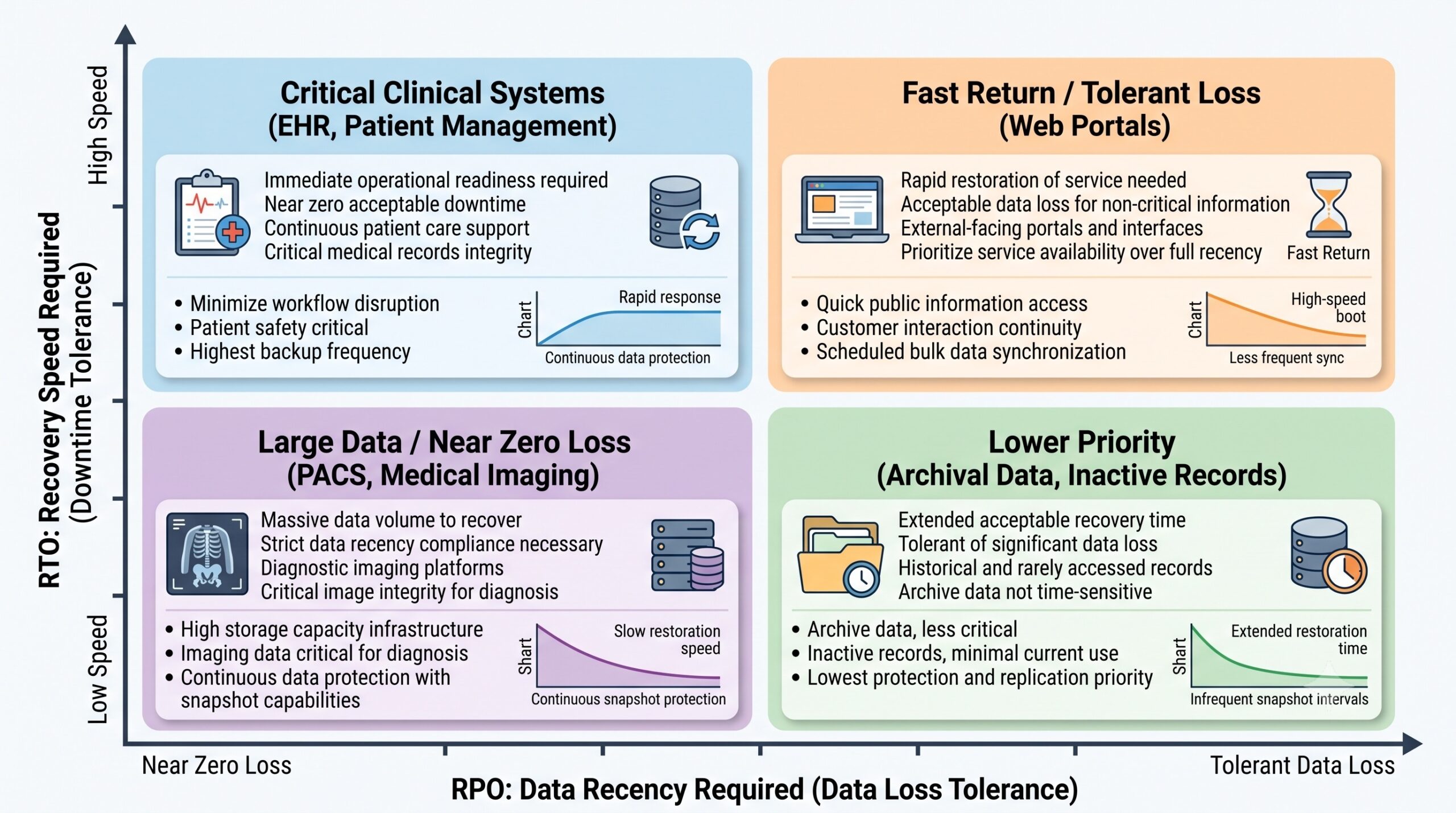
Workload-specific alignment of healthcare systems based on downtime tolerance and data loss sensitivity.
RTO and RPO for EHR and EMR Systems
Electronic health record systems may contain:
- Patient charts
- Medication information
- Clinical documentation
- Orders
- Audit data
- Provider notes
Downtime can restrict access to information used during clinical workflows, while restoring an older recovery point can mean losing recent patient changes.
Both downtime tolerance and data-loss tolerance therefore need to be evaluated carefully.
RTO and RPO for Patient Management and Scheduling Systems
Patient management platforms may support registration, appointments, scheduling, billing, and front-office workflows.
- The RTO should reflect how long staff can continue operating when these processes are unavailable.
- The RPO should reflect the consequence of losing recent appointment, patient, or administrative changes.
RTO and RPO for PACS and Medical Imaging Systems
PACS and diagnostic imaging environments present a different recovery challenge.
Recovery planning may need to account for:
- Large datasets
- Network bandwidth
- Imaging workflow
- Storage performance
- Clinical dependencies
- System integrations
The priority should be based on how imaging availability affects the organization’s specific diagnostic and care workflows.
RTO and RPO for Healthcare Billing and Revenue Cycle Systems
Billing platforms may have a different recovery priority from patient-facing clinical systems, but extended downtime can still affect claims processing, cash flow, and administrative operations.
Their RTO and RPO should therefore be established independently rather than inherited from another system.
RTO and RPO for Healthcare Archives and Lower-Change Workloads
Some archival data changes less frequently and may not require the same recovery speed as active clinical applications.
These systems can often use a different recovery tier, provided their objectives still meet regulatory and operational requirements.
The key principle is:
Recovery objectives should be workload-specific, not organization-wide defaults.
How RTO and RPO Support HIPAA Contingency Planning
HIPAA does not prescribe one universal numerical RTO or RPO for healthcare organizations.
Instead, the HIPAA Security Rule’s contingency-planning provisions require regulated entities to establish plans for backing up ePHI, restoring lost data, and continuing critical processes during emergencies. The rule also addresses periodic testing and revision and applications-and-data criticality analysis. (HHS.gov)
HHS specifically identifies a data backup plan, disaster recovery plan, emergency mode operation plan, testing and revision procedures, and applications/data criticality analysis within contingency planning. (HHS.gov)
That distinction matters.
HIPAA contingency requirements should not be converted into arbitrary statements such as:
“Every healthcare organization needs a 15-minute RPO.”
A small dental practice, multi-site clinic, imaging provider, SaaS healthcare vendor, and hospital may have very different systems and consequences of downtime.
RTO and RPO should be established through risk analysis, criticality analysis, operational requirements, and realistic recovery capability.
Why Backups Alone Cannot Meet RTO and RPO Requirements
Having a backup does not prove that an organization can meet either recovery objective.
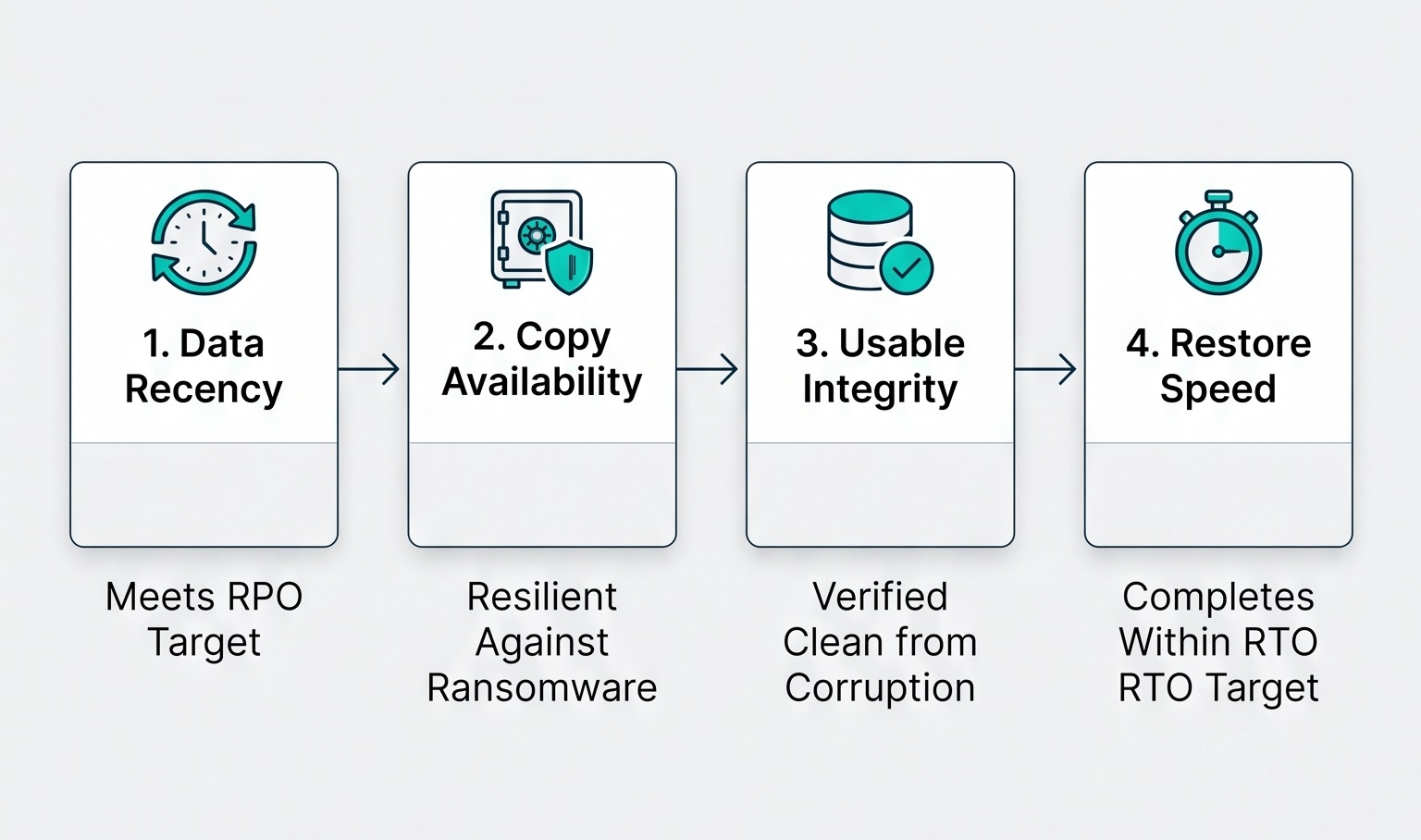
Why backups alone cannot guarantee recovery: four technical hurdles every restore must clear.
Four different conditions must line up.
Recovery Points Must Meet the Required RPO
If the RPO is 30 minutes but the latest viable recovery point is six hours old, the RPO has already been missed.
Backups Must Remain Available During Recovery
Backups that were deleted, encrypted, inaccessible, or otherwise compromised cannot support recovery when they are needed.
This is one reason isolated and immutable copies are used as part of ransomware-resilient recovery design.
Recovery Points Must Be Clean and Usable
The newest backup is not automatically the best recovery point.
A recent snapshot could contain:
- Corrupted data
- Broken database state
- Ransomware
- Malicious persistence
- Missing application dependencies
Following a cyber incident, the objective may be to identify a verified clean restore point rather than automatically choosing the newest copy.
This creates an important distinction:
- RPO measures recovery-point recency.
- Recovery integrity determines whether that recovery point should actually be used.
A recovery point needs to be recent and intact and safe enough for the intended recovery process.
Restore Operations Must Finish Within the RTO
Even a perfect backup does not satisfy a two-hour RTO if restoring, validating, and returning the application to operation takes ten hours.
Recovery time should include the steps necessary to return the workload to a usable state – not merely the time required to copy data from storage.
That is why backup monitoring and recovery testing answer different questions:
- Backup monitoring: Did the protection job run?
- Recovery testing: Can the system actually return to operation within the required recovery window?
How to Test Whether Your RTO and RPO Are Achievable
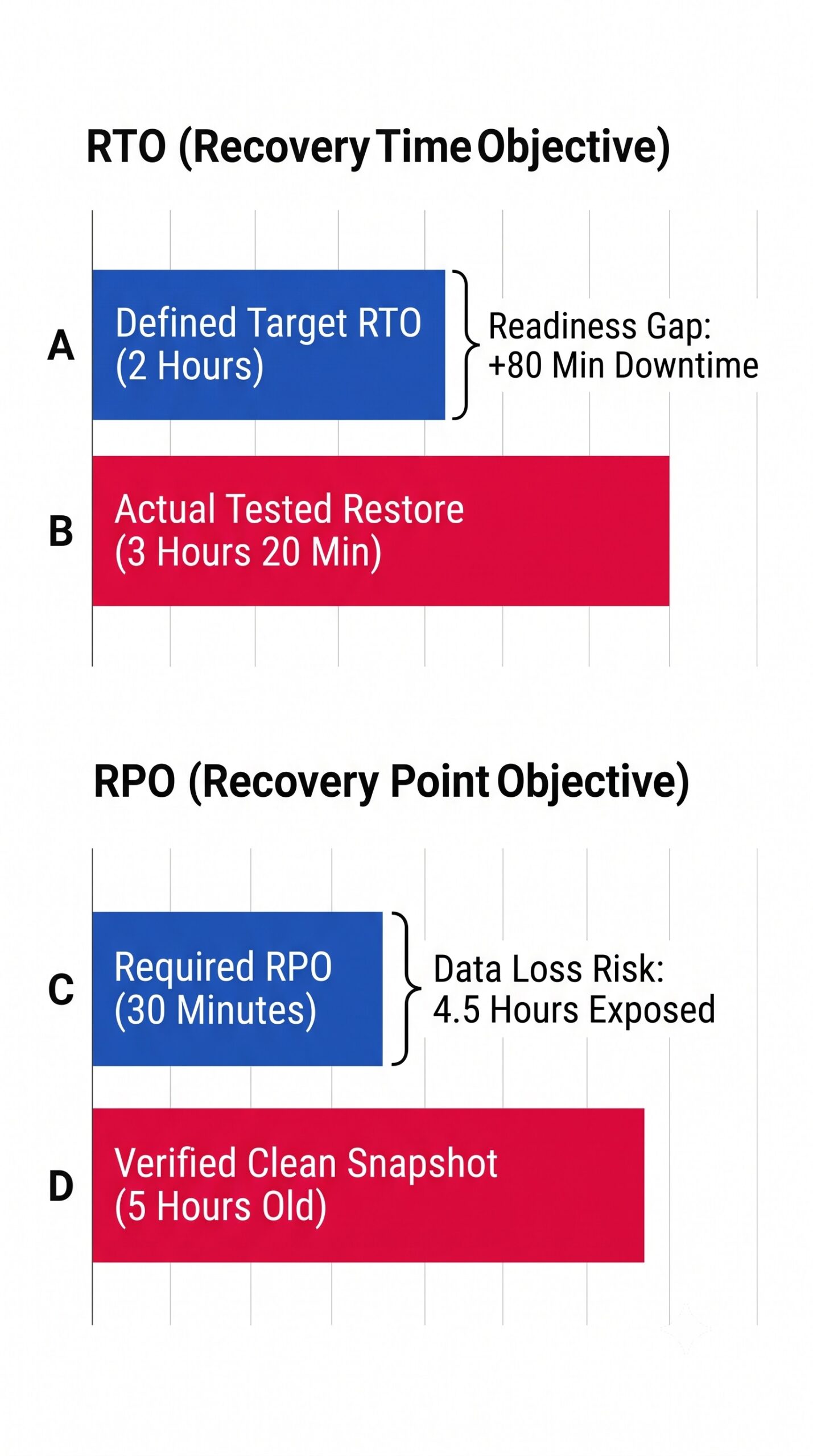
Auditing disaster recovery: comparing paper objectives against measured restoration benchmarks.
Once objectives have been established, every critical workload should be evaluated against a small set of practical questions:
- What is the workload’s defined RTO?
- What is its defined RPO?
- When was it last successfully restored?
- What was the measured recovery time?
- How recent was the recovery point used during testing?
- Were application and database integrity validated?
- Were system dependencies included?
- Could the same recovery process work if the production environment were compromised?
The gap between the answers is more useful than a backup-success percentage.
For example:
- Required RTO: 2 hours
- Last tested recovery time: 3 hours 20 minutes
The backup may work, but the recovery architecture does not currently demonstrate the required RTO.
Or:
- Required RPO: 30 minutes
- Protection interval: 15 minutes
- Latest verified clean restore point: 5 hours old
The protection cadence appears strong, but the usable recovery point still fails the business requirement.
Recovery readiness should be measured against recoverable outcomes rather than backup existence alone.
How CDS Helps Organizations Meet RTO and RPO Targets
Defining recovery objectives is only the first step.
Organizations also need to determine whether their recovery architecture, backup integrity, and operational process can consistently meet those objectives.
Central Data Storage (CDS) supports this through managed backup, disaster recovery, and recovery-validation capabilities designed for healthcare and other regulated environments.
The recovery approach focuses on three connected requirements:
- Recovery speed – Can critical workloads return within the required RTO?
- Recovery-point recency – Is appropriate data available within the required RPO?
- Restore integrity – Is the selected recovery point complete, usable, and appropriate to return to production?
CDS recovery capabilities can include backup protection, restore assistance, recovery validation, ransomware-aware recovery workflows, and support for cloud, hybrid, and on-premises environments.
That helps organizations move from:
“We have backups.”
to:
“We have defined recovery objectives and evidence that our recovery process is designed to support them.”
Assess Your Current RTO and RPO Recovery Gaps
A documented RTO or RPO is useful only when the underlying recovery process can support it.
Explore CDS disaster recovery solutions and recovery assessment options to evaluate backup architecture, restore readiness, recovery-point integrity, and the gap between your required recovery targets and current capability.
RTO and RPO FAQs
Who Should Define RTO and RPO Targets?
RTO and RPO should be established collaboratively. Business, clinical, and operational owners define the consequences of downtime and data loss, while IT and recovery teams determine the infrastructure, backup, replication, and recovery processes necessary to support those requirements.
A backup vendor should not determine recovery objectives in isolation.
Does HIPAA Require Specific RTO or RPO Targets?
No universal numerical RTO or RPO is specified by the HIPAA Security Rule. HIPAA requires contingency planning around backup, disaster recovery, emergency operations, and protection of ePHI, while organizations must determine recovery requirements appropriate to their risks, applications, and operational needs. (HHS.gov)
Can Different Systems Have Different RTO and RPO Targets?
Yes. Recovery objectives should reflect each workload’s operational importance, data-change rate, dependencies, and consequences of downtime or data loss. An EHR platform, billing system, PACS environment, scheduling application, and archive may therefore require different recovery targets.
Is a Lower RTO or RPO Always Better?
Not necessarily. Lower objectives usually require greater infrastructure, protection frequency, automation, and operational investment. Recovery targets should be as aggressive as the business requires – not simply as low as technology can make them.
Does Frequent Backup Guarantee a Low RPO?
No. Frequent backups can help provide more recent recovery points, but RPO also depends on whether those recovery points exist, remain accessible, and are usable after the incident. A recent but corrupted or compromised backup may not provide a viable recovery point.
Can a Recovery Meet RPO but Fail RTO?
Yes. A backup may contain sufficiently recent data to satisfy the RPO while taking too long to restore, validate, and return the application to service. In that case, the RPO is supported but the RTO is missed.
Build Disaster Recovery Around RTO, RPO, and Recovery Outcomes
RTO and RPO define two fundamental requirements for disaster recovery.
- RTO defines how quickly operations need to return.
- RPO defines how recent recovered data needs to be.
But neither objective should exist only in documentation.
Effective recovery planning connects business impact, workload criticality, backup and replication architecture, recovery sequencing, system dependencies, clean recovery points, and measured restore testing.
For healthcare organizations, that means evaluating EHR systems, patient management software, imaging, scheduling, billing, databases, and other workloads according to their actual role in patient care and operations.
The objective is not simply to create more backups.
It is to know:
what must recover, how quickly it must recover, how much data can be lost, and whether the organization has demonstrated that the recovery process can actually deliver that outcome.
Schedule a disaster recovery assessment with Central Data Storage to identify gaps between your required RTO and RPO targets and your current recovery capability.