What Healthcare Organizations Should Look for in a BDR Managed Service
A healthcare organization should look for a BDR managed service that can protect ePHI, restore critical systems quickly, prove backups are recoverable, and support the team during a real incident. Backup alone is not enough.The real standard is whether the provider can deliver clean recovery, practical recovery targets, strong documentation, and dependable support when operations are under pressure.
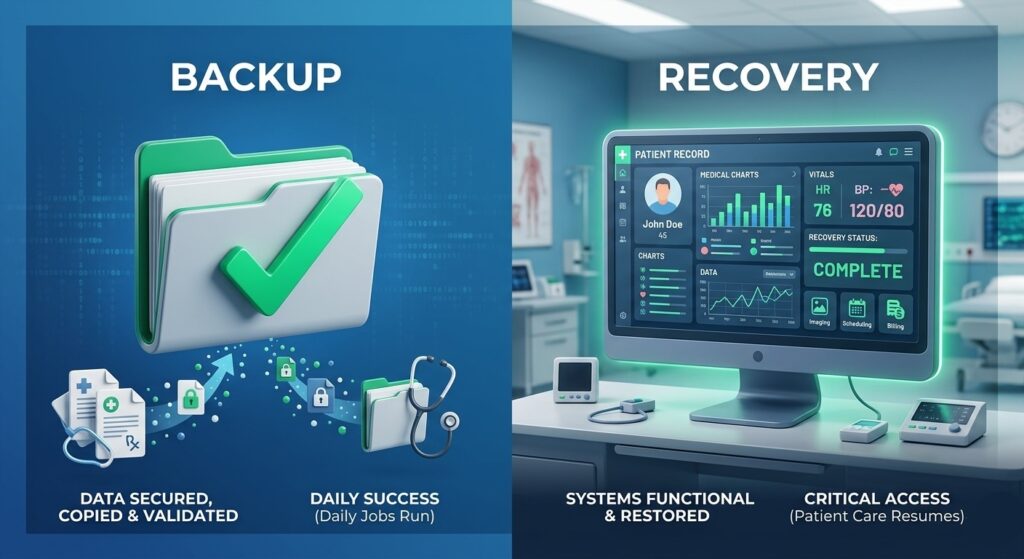
A successful backup job is a starting point, but verified recovery is the goal.
That matters because healthcare downtime affects more than IT. It can interrupt chart access, scheduling, billing, imaging, and clinical workflows tied to patient care. This should be treated as a recovery decision, not a storage purchase.
What a Healthcare BDR Managed Service Should Include
A healthcare BDR managed service should combine backup, disaster recovery, monitoring, restore support, and recovery planning in one model. It should help an organization recover after ransomware, hardware failure, corruption, or site-level disruption.
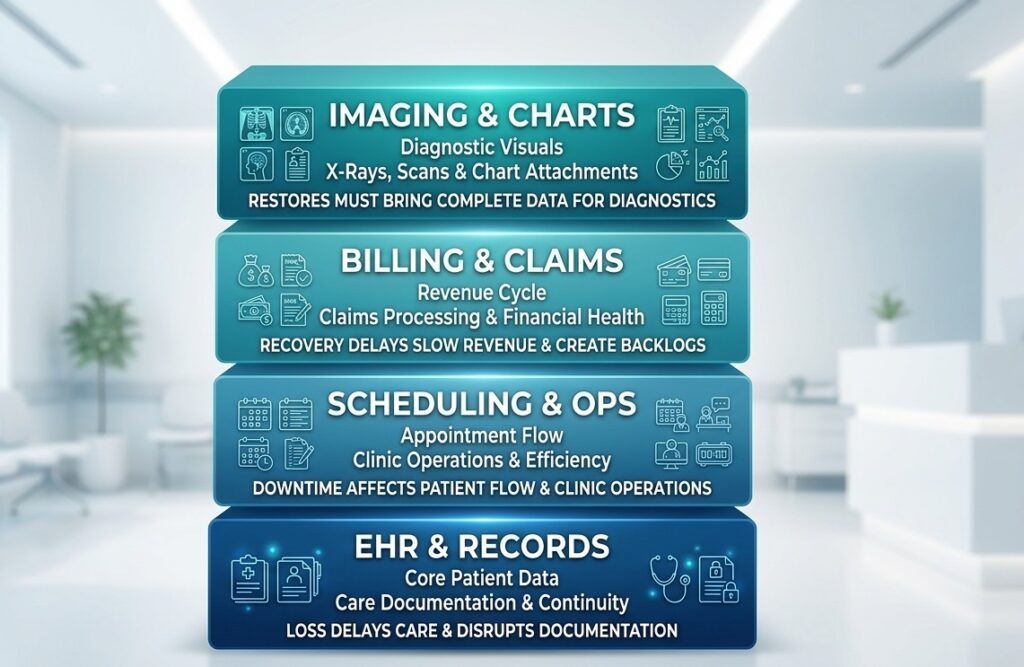
Protecting the systems that keep your organization operating.
Healthcare buyers are not protecting files alone. They are protecting the systems that keep the organization operating:
| Protected area | Why it matters |
| EHR and patient records | Loss or inaccessibility can delay care and disrupt documentation |
| Scheduling and front-desk systems | Downtime affects operations and patient flow |
| Billing and claims tools | Recovery delays can slow revenue and create backlogs |
| Imaging, charting, and attachments | Restores must bring back complete, usable data |
| The recovery path itself | A backup only matters if it can be restored safely and on time |
Basic backup answers one question: was a copy created?
Managed BDR has to answer harder questions:
- Can the data be restored?
- How fast can systems come back?
- Who helps during the incident?
- What happens if backups are corrupted or infected?
- Is recovery tested, documented, and aligned with healthcare risk?
Healthcare teams evaluating managed backup and disaster recovery should treat recoverability, support, and infrastructure control as buying criteria, not secondary features.
HIPAA, BAA and PHI Requirements to Confirm Before Signing
A healthcare BDR provider should support the three outcomes HIPAA expects for ePHI: confidentiality, integrity, and availability. In practical terms, that means protecting patient data from unauthorized access, preserving data accuracy, and making systems recoverable when something fails.
A provider should be able to explain how the service supports:
- encryption in transit and at rest
- MFA and role-based access controls
- backup and restore logging
- verification of restore integrity
- offsite redundancy and recovery procedures
A Business Associate Agreement is also a basic requirement when the vendor handles PHI. Before signing, buyers should confirm:
- whether the provider will sign a BAA
- which services the BAA covers
- how subcontractors are handled
- what breach-reporting obligations apply
This is also why broader healthcare data protection should be part of the evaluation, not just the backup feature list.
Why Verified Recovery Matters More Than Backup Success
A successful backup job does not prove successful recovery. It only proves that data was copied somewhere. It does not prove the copy is clean, complete, uncorrupted, usable, or restorable within the time your organization can tolerate.
Healthcare teams do not recover backup jobs. They recover chart access, imaging systems, scheduling workflows, billing platforms, and patient-facing operations.
Clean data backup supports clean data recovery. If backups contain corrupted files or infected restore points, recovery can bring those problems back into production.
A serious backup provider should be able to prove that restored data is:
- complete
- uncorrupted
- uninfected
- restorable within a practical window
- documented through reports and logs
That is why backup verification and recovery should be treated as a decision factor, not a background feature. Healthcare organizations comparing vendors should ask how restore testing is performed, what proof is provided, and what happens if recovery fails.
How to Evaluate RTO, RPO, and Recovery Speed
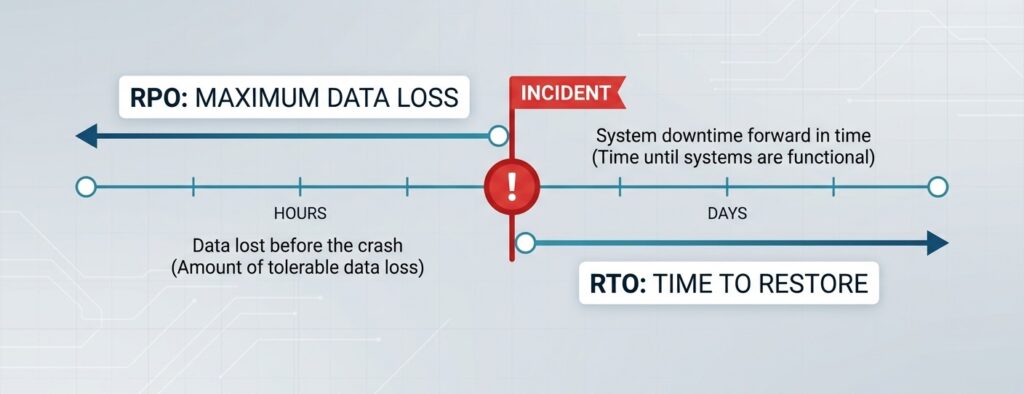
Defining recovery expectations in operational terms, not vague promises.
- Recovery Time Objective (RTO) is the maximum amount of time a system can be unavailable after an outage or cyber incident.
- Recovery Point Objective (RPO) is the maximum amount of data loss your organization can tolerate, measured in time.
These are not abstract IT metrics in healthcare. They directly affect how quickly staff regain access to charts, scheduling, billing, imaging workflows, and day-to-day clinical coordination.
A provider should be able to define recovery expectations in operational terms, not vague promises.
| Recovery question | What buyers should expect |
| How quickly can critical systems come back? | A realistic RTO range tied to system type |
| How much recent data could be lost? | A defined RPO based on backup frequency |
| What gets restored first? | Clear sequencing for business-critical systems |
| What support is included during recovery? | Specific escalation and restore assistance |
If recovery language stays broad and unmeasured, the buyer cannot tell whether the service fits real healthcare operations. This is where disaster recovery planning becomes relevant, because recovery speed depends on preparation, sequencing, and support, not storage alone.
What to Ask About Ransomware Recovery
Ransomware recovery is not just a backup question. It is a recovery-path question.
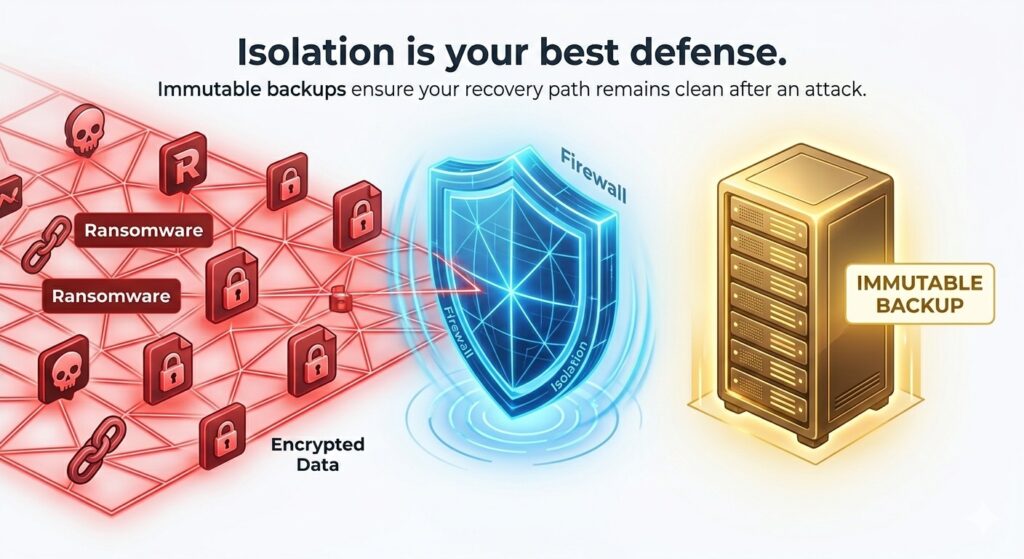
Immutable backups ensure your recovery path remains clean after an attack.
A healthcare organization may have backups and still fail to recover if the provider cannot explain:
- how backup copies are protected from the same attack path
- how clean restore points are identified
- how corruption or hidden infection is detected
- who guides recovery when time matters
Healthcare buyers should ask about controls such as immutable backups, isolated copies, offsite redundancy, and strict access restrictions. A useful test question is simple:
If ransomware hits our environment, what keeps the backup set from becoming part of the same incident?
The right answer should include backup protection, isolation, restore validation, and a clear recovery process. Buyers should also ask whether the provider can support clean restores, not just fast restores.
Which Backup Architecture and Deployment Options Matter Most
The right backup architecture should support both fast recovery and survivability.
An image-based backup matters because it captures a full system state, not just selected files. That can reduce rebuild time when the organization needs to restore an entire server or workstation environment, including the operating system, settings, applications, and data.
Healthcare organizations should also avoid relying on one copy in one place. A stronger design usually includes a combination of:
- local backup for certain day-to-day restores
- offsite protection for site-level disruption
- cloud or private infrastructure for geographic resilience
- hybrid recovery paths for balance between speed and survivability
Hosting and deployment also matter because they affect control, vendor dependency, compliance posture, and long-term flexibility. Buyers should ask:
- Is the service fully managed, self-hosted, or both?
- Does the provider rely on third-party hyperscalers?
- Can the solution run in a private or hybrid environment?
- What happens if tighter infrastructure control is needed later?
For organizations that care about deployment flexibility, CDS positions UnisonBDR across managed, self-hosted, and licensed models. That makes architecture a buying decision, not just a technical detail.
Why Healthcare Experience Should Influence Vendor Selection
Healthcare recovery is not the same as generic business IT recovery.
Restoring a healthcare environment often means bringing back a chain of dependent systems in the right order, including EHR access, front-desk workflows, billing, imaging, charting, and staff access to current clinical information.
Healthcare environments may also include:
- imaging systems with large files and workflow dependencies
- connected medical devices
- integrated practice software
- multi-site clinic operations
A provider with real healthcare experience should be able to explain:
- which systems are restored first
- how continuity is supported during downtime
- how PHI is handled during backup and restore
- how recovery sequencing changes across healthcare environments
A vendor that speaks only in generic MSP language may understand storage, but not necessarily healthcare recovery risk.
What Incident Support a Managed BDR Provider Should Deliver
A managed BDR service should not stop at scheduled backups. It should also detect backup failures, missed windows, corruption risk, and unusual activity that can break recovery later.
Real-time assistance when operations are under pressure.
Healthcare incidents do not wait for business hours. Delayed response can extend downtime across scheduling, chart access, billing, and multi-site coordination.
Hands-on recovery support should include:
- incident triage
- guided restoration steps
- technical escalation when recovery is delayed or compromised
- direct communication during the event
- post-incident review and documentation
This is one area where CDS’s positioning is commercially strong: UnisonBDR is framed around human-led, 24/7 U.S.-based support rather than software-only recovery tooling.
How to Compare Support, Recovery, and Infrastructure Control
By this point, three patterns should be clear. A strong healthcare BDR provider should be able to:
- prove recoverability
- explain how recovery works under pressure
- show who owns support when systems are down
If a vendor cannot do those three things clearly, the rest of the feature list matters less.
Buyers who want to compare those standards against CDS’s product approach can review UnisonBDR.
What to Ask About Pricing Before You Sign
Pricing matters because recovery costs often become most visible when the organization is already under pressure.
A predictable pricing model reduces risk in three areas:
- budget stability
- incident response
- vendor comparison
The biggest pricing trap is not always storage cost. It is what happens when the organization actually needs to recover data.
Every vendor should be asked:
- Are there egress or retrieval fees during recovery?
- Are restores priced separately from storage?
- Does pricing change by deployment model?
- Is incident support included, or billed separately?
A low monthly price does not mean low recovery risk. Buyers should compare recovery cost, support inclusion, infrastructure model, and validation value together.
CDS’s product positioning emphasizes flat-rate pricing and no egress or retrieval penalties, which is a meaningful differentiator for buyers trying to avoid recovery-time surprises.
Which Reports and Documentation a BDR Provider Should Deliver
A healthcare BDR provider should produce records that show more than whether a backup ran. Useful reporting shows what was protected, what was tested, and what can be restored.
| Report Area | What It Should Show |
| Backup activity | When backups ran and whether failures occurred |
| Restore activity | What was restored and whether the restore completed successfully |
| Verification results | Whether backups were tested and confirmed recoverable |
| Administrative actions | Key changes, access events, and relevant system activity |
In healthcare, documentation matters because recovery decisions may later be reviewed by leadership, compliance stakeholders, insurers, or outside advisors. CDS provides:
- Backup and restore activity logs
- Verification and clean recovery reports
- Encryption documentation
- Data retention documentation
- Infrastructure security summaries
- BAA documentation for qualifying plans
- ISO 27001 certification records
Before signing, ask what recovery evidence you will actually receive, whether test restores are documented, which logs are retained, and whether the provider can support internal risk reviews or audit preparation.
Red Flags to Watch for in a Healthcare BDR Provider
Some BDR providers sound strong because they talk about security, uptime, and resilience in broad terms. The real question is whether they can explain how recovery works under pressure.
| Red Flag | Why It Matters |
| Backup success discussed but not restore validation | A completed backup does not prove recoverability |
| Recovery timelines are vague | Buyers cannot judge whether operations can resume in time |
| Pricing sounds low until restore activity is discussed | Hidden recovery or support fees may appear later |
| Compliance answers are generic | Healthcare teams need clear answers on BAAs, logging, encryption, and access control |
| Support language is broad | “24/7 support” means little without clear escalation and ownership |
| Vendor relies on third-party cloud they don’t control | If the cloud goes down, your recovery goes down with it |
Healthcare-specific warning signs:
- No clear BAA process
- Weak answers on PHI handling during backup and restore
- No discussion of restore sequencing or operational impact
- No usable logs, reports, or recovery evidence
- No clear answer on clean restore capability after ransomware
- No ISO 27001 or equivalent third-party certification
If a provider cannot explain how backups are verified, what gets restored first, how long recovery usually takes, and what proof is provided afterward — the buyer is being asked to trust a service without evidence.
Questions to Ask Before Choosing a Healthcare BDR Provider
A healthcare BDR evaluation should end with direct questions, not assumptions.
Questions about recoverability and restore testing
| Question | Why It Matters |
| How do you verify that backups are recoverable? | Confirms whether restore validation exists |
| How often are test restores performed? | Shows whether recovery is practiced, not assumed |
| What proof do we receive after testing? | Buyers need reports, logs, or validation evidence |
| How do you detect corruption or compromised backup data? | Helps assess whether the restore path is trustworthy |
| What happens if a restore fails? | Clarifies escalation and remediation support |
Questions about HIPAA, BAAs, and PHI handling
| Question | Why It Matters |
| Will you sign a BAA for the service being purchased? | Confirms whether PHI handling is contractually supported |
| Is data encrypted in transit and at rest — starting at our location? | Confirms 256-bit AES encryption begins at the client site, not just at the vendor |
| What access controls are supported? | Helps assess MFA and least-privilege setup |
| What logs are retained for backup, restore, and admin actions? | Supports auditability and internal review |
| Where is the data hosted, and who owns that infrastructure? | Clarifies dependency and control |
Questions about ransomware, pricing and support
| Question | Why It Matters |
| What prevents ransomware from affecting backup copies too? | Tests backup isolation and protection design |
| How do you support clean restores after ransomware? | Clarifies whether safe recovery is built into the service |
| Are there egress, retrieval, or restore-related fees? | Helps uncover hidden pricing risk |
| What support is included during an active outage? | Shows whether the vendor provides hands-on recovery help |
| Who owns the incident path once restoration begins? | Clarifies accountability during downtime |
If the answers are vague, incomplete, or overly sales-led, the provider may not be ready for real-world healthcare recovery.
Final Checklist – What the Right Healthcare BDR Managed Service Should Deliver
The right provider should help a healthcare organization do three things well: protect data, restore operations, and reduce uncertainty during an incident.
| Requirement | What Good Looks Like |
| Recoverability | Backups are tested, validated, and supported by evidence — not just reported as complete |
| Healthcare fit | The provider understands PHI, clinical downtime, and system dependencies |
| Ransomware readiness | Backup copies are protected, immutable, and clean restore processes are defined |
| Recovery targets | RTO and RPO are discussed in practical, documented operational terms |
| Support model | Real incident support from people — not software access and a ticketing queue |
| Pricing clarity | Recovery-related costs are predictable and never hidden in egress or retrieval fees |
| Documentation | Backup, restore, verification, and compliance records are available on demand |
| Infrastructure | Private, U.S.-owned infrastructure — not shared third-party cloud |
| Certification | ISO 27001 certified and HIPAA-aligned from the ground up |
A basic backup provider creates copies. A strong recovery partner helps your team restore safely, quickly, and with proof.
Clean data backup = clean data recovery.
The only way to know your backup works is to verify it before a crisis forces the question.
Compare Your Current Backup Approach Against a Real Recovery Standard
If your organization is evaluating healthcare BDR providers, the next step is to move from claims to proof. Ask to see the recovery process, sample reports, validation evidence, pricing clarity, deployment options, and support scope.
To compare those standards against CDS’s live product offering, review healthcare backup recovery options with UnisonBDR. If your first priority is proving that recoveries are usable before a crisis forces the question, start with verified restore readiness.
A provider that cannot show how recovery works, what it costs, who supports it, and how it is verified may still offer backups, but it is not a strong healthcare recovery choice.
Book Your Free Healthcare Data Risk Assessment → centraldatastorage.com | 888-907-1227
FAQS Healthcare BDR Managed Service
How long does healthcare BDR deployment take?
Healthcare BDR deployment usually takes days to weeks. Deployment time depends on server count, data volume, network speed, compliance review, initial backup time, restore testing, and user handoff.
How often should a healthcare BDR service test restores?
A healthcare BDR service should test restores on a defined schedule and after major system changes. Restore testing should verify data integrity, application usability, ransomware safety, and recovery time against target RTO and RPO.
Can a healthcare BDR service protect Microsoft 365 and cloud apps?
A healthcare BDR service should protect Microsoft 365, cloud apps, servers, endpoints, and critical databases. Native cloud retention does not always provide full recovery, long-term retention, or clean restore control.
What retention period should a healthcare BDR provider support?
A healthcare BDR provider should support retention based on legal, operational, and recovery needs. Retention should cover daily restores, ransomware rollback, audit support, and long-term record preservation without reducing restore visibility.
How do you switch from a current backup vendor to a new BDR provider?
A healthcare organization should switch backup providers through staged migration. The team should assess current backups, deploy the new platform, run the first full backup, validate restores, confirm retention, and retire the old vendor after proof.