A Non-profit’s ability to operate depends heavily on its data, but what actually happens when that data is suddenly lost?
When data loss occurs, Non-profits don’t just lose files; they lose access to the systems that keep operations running. Donor records, financial data, and program information can become unavailable, communication slows down, and reporting processes are disrupted. What begins as a technical issue quickly turns into an operational challenge.
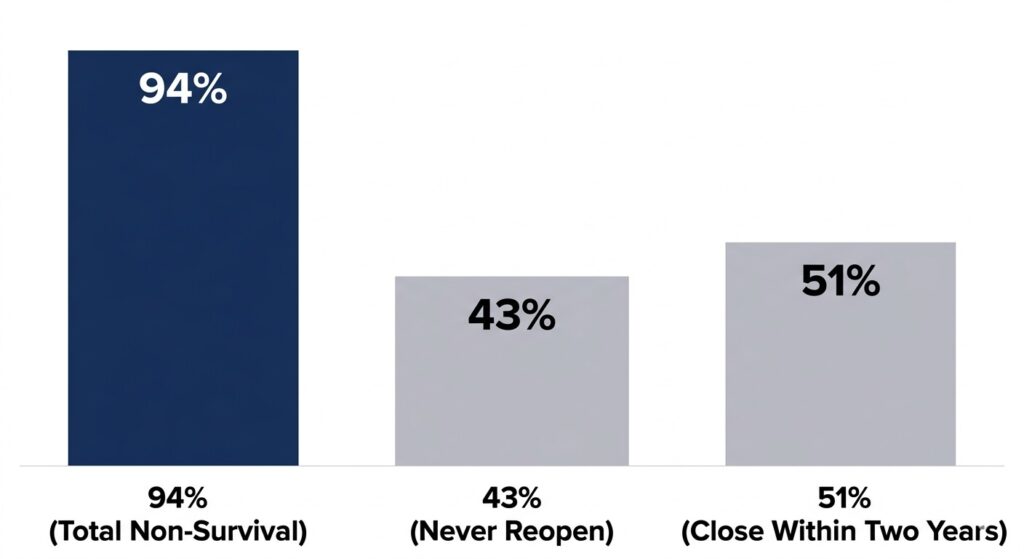
The statistics for surviving a major data loss event are stark for any organization.
In many cases, the bigger problem isn’t the data loss itself, it’s whether the organization can recover from it. Studies show that around 94% of companies suffering from a catastrophic data loss do not survive, 43% never reopen, and 51% close within two years. (Source)
This is why data loss is rarely an isolated incident. It triggers a chain of events that affects fundraising, compliance, and long-term sustainability.
To reduce this risk, Non-profits are increasingly adopting structured Non-profit data protection solutions that focus on both protection and recovery.
How Non-profit Data Loss Starts and Remains Unnoticed
Data loss in non-profits rarely begins with a major incident. In most cases, it starts with a small issue that appears harmless and goes unnoticed until recovery is required.
Top Causes of Non-profit Data Loss
Most data loss events come from a few recurring sources that are easy to overlook in day-to-day operations:
- Human error: Files may be accidentally deleted, overwritten, or shared incorrectly without immediate realization
- Cyberattacks and ransomware: Attacks often begin quietly, targeting data access or backups before causing visible disruption
- System failures or misconfigurations: Storage issues, software errors, or incorrect settings can affect data integrity over time
In many cases, these events don’t immediately stop operations, which is why they are often ignored at first.
Why Nonprofit data loss goes undetected
The real risk lies in delayed detection. Backups can fail without alerts, and corrupted data may remain undetected while systems continue to function. This creates the assumption that recovery is possible until it is actually needed.
In many cases, organizations only discover the issue during a restore attempt, when data is incomplete, outdated, or unusable. Problems like this are commonly linked to silent data corruption, where data appears intact but cannot be reliably recovered.
What happens when Non-profit Systems Fail after Data Loss?
When data loss becomes visible, the first impact is on system access. Core platforms that Non-profits rely on daily begin to slow down or stop working entirely, making it difficult to continue normal operations.
Systems Affected by Non-profit Data Loss
The disruption typically affects the systems that hold and process critical information:
- Donor databases become inaccessible or outdated: Teams lose visibility into donor history, contributions, and engagement, making it difficult to manage relationships or run campaigns effectively.
- CRM platforms stop syncing or retrieving records: Data across teams becomes inconsistent, leading to confusion, duplicate efforts, or missed follow-ups.
- Shared files and internal systems are no longer available: Staff cannot access essential documents, reports, or schedules needed for daily operations.
These systems are interconnected, so a failure in one often affects others.
How Data Loss Disrupts Non-profit Operations?
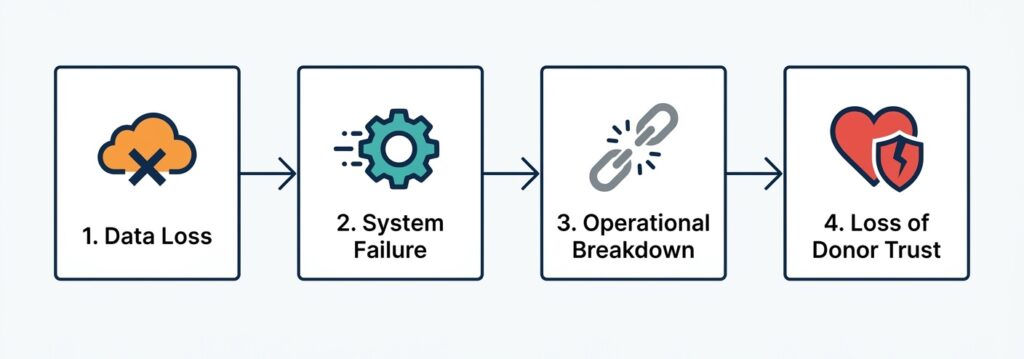
Data loss creates a ripple effect that eventually compromises your mission and reputation.
As access to systems declines, routine activities begin to break down:
- Fundraising slows because donor data cannot be accessed: Campaigns lose momentum when teams cannot identify donors, track contributions, or personalize outreach.
- Communication becomes inconsistent due to missing contact records: Messages may be delayed, duplicated, or sent to the wrong recipients, affecting engagement.
- Program coordination is delayed as internal documents become unreliable: Teams struggle to manage schedules, resources, and deliverables without accurate information.
At this point, the issue moves beyond IT and starts affecting overall operations.
To maintain continuity during such disruptions, organizations rely on structured disaster recovery solutions that help restore systems and resume operations.
When systems become unavailable, the ability to restore operations depends on how well recovery processes are designed—not just whether backups exist. This gap is explained in
Impact of Data Loss on Non-profit Operations and Trust
Once systems are disrupted, the impact extends beyond operations. Data loss begins to affect how the organization communicates, reports, and maintains trust.
How Data Loss Affects Donor Trust?
Donor data is central to Non-profit outreach and engagement. When records are missing or inaccessible, communication becomes inconsistent.
Past contributions, preferences, and history may not be available, making it difficult to maintain meaningful relationships. Even short disruptions can create gaps that affect long-term donor confidence.
Financial Impact of Non-Profit Data Loss
Financial visibility is reduced when transaction records are incomplete or unavailable. Reporting cycles may be delayed, and funding decisions can be affected due to lack of accurate data.
For Non-profits that rely on grants or structured reporting, this creates immediate operational pressure.
Compliance Risks after Non-profit Data Loss
Data loss also introduces compliance challenges. Missing documentation, incomplete records, or inconsistent data can increase audit exposure.
Organizations may struggle to demonstrate data integrity or meet reporting requirements. This becomes more critical in regulated environments, where data availability and accuracy are expected at all times.
Why Restores Often Break Down for Many Non-profits?
At this stage, most Non-profits expect recovery to resolve the issue. The assumption is simple: if backups exist, data can be restored. In practice, this is where many organizations encounter the biggest failure.
Why do Backups not Guarantee Successful Data Recovery
At this stage, most non-profits expect that they can restore their data using backups. The assumption is simple: If backups exist, recovery should work. However, many organizations discover that their backups cannot be used when they actually need them.
Research shows that less than half of businesses are able to fully recover their data after a disaster, often due to issues within their backup systems. [source]
Common Backup Failures that Prevent Recovery
Most backup failures are not obvious until recovery is attempted. Typical issues include:
- Corrupted backup data: Backup files may exist but contain damaged or unreadable data, making them unusable during restoration.
- Outdated backup versions: The available backup may not include recent updates, leading to loss of critical donor, financial, or operational data.
- Overwritten or missing recovery points: Older backups may be replaced automatically, leaving no clean version to restore from when needed.
- Lack of version control: Without multiple restore points, organizations cannot go back to a specific point in time before the issue occurred.
- Ransomware-infected backups: In some cases, attacks spread to backup systems, meaning both primary and backup data are compromised.
What Happens During a Failed Data Recovery Attempt?
When recovery fails, the situation escalates quickly:
- Incomplete data restoration: Systems may come back online, but key data is missing or inconsistent.
- System instability after restore: Applications may not function properly due to partial or corrupted data recovery.
- Extended downtime: Multiple recovery attempts are required, increasing the time systems remain unavailable.
- Uncertainty in recovery process: Teams struggle to identify which backup is usable, delaying decision-making and recovery efforts.
This is where most Non-profits face the biggest gap—backups exist, but recovery does not work as expected. This is why backup verification and recovery are critical to ensure data can actually be restored.
Central Data Storage (CDS) addresses this by validating backup integrity and ensuring clean, usable recovery points before an incident occurs.
The Long-term Damage of Data Loss And Failed Recovery
When recovery takes longer than expected or fails, the impact continues to grow. What starts as a system issue turns into a long-term operational and financial challenge.
How Downtime affects Nonprofit Operations
When systems remain unavailable, normal operations cannot resume. Teams lose access to essential data, which slows down workflows and reduces overall productivity. In many cases, organizations are forced to rely on temporary manual processes, which are slower and more error-prone.
Financial Losses from Data Loss
Delays in system recovery directly affect fundraising and financial operations. Without access to donor data, outreach efforts become limited, and campaign execution is disrupted. At the same time, organizations may incur additional costs while attempting to restore data, manage downtime, or seek external support.
Reputational Damage and Loss of Donor Confidence
As disruptions continue, the impact becomes visible to donors and stakeholders. Communication gaps, missing records, or delayed responses can affect trust. Over time, this can weaken relationships and make it more difficult to maintain consistent support. Prolonged downtime also affects business continuity planning.
What Determines Successful Non-profit Data Recovery?
Not all Non-profits face the same outcome after data loss. Some are able to restore systems quickly, while others experience prolonged disruption. The difference lies in how their recovery process is designed and validated.
Difference Between Backup and Recovery
Storing data and recovering data are not the same.
- A backup ensures data is copied and stored.
- Recovery determines whether that data can be restored completely, accurately, and within a usable timeframe.
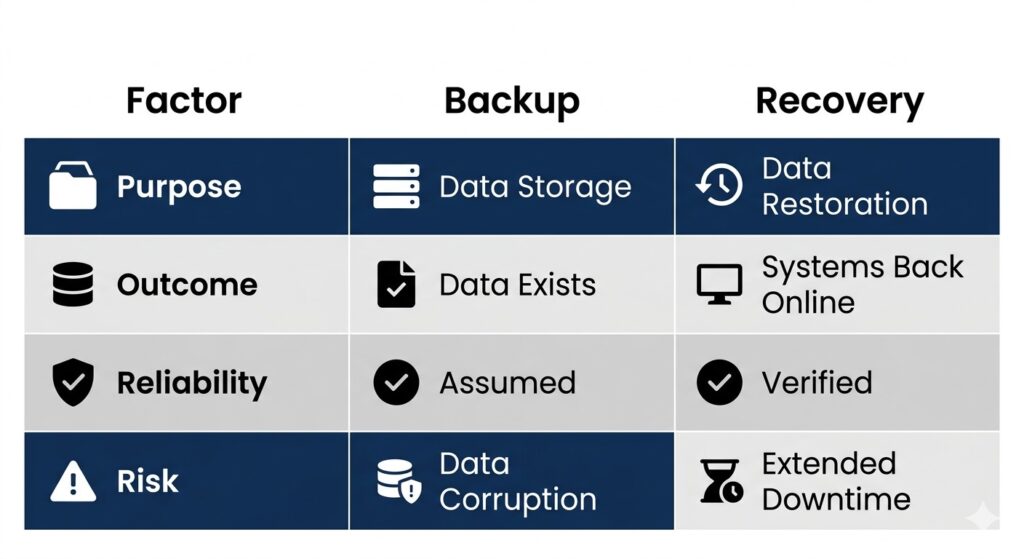
Understanding the difference between storage and usability is critical for continuity.
This distinction is central to how Central Data Storage (CDS) approaches data protection—focusing on verified recovery rather than assuming backup success.
Why Backup Verification Improves Data Recovery
Recovery success depends on whether backups have been tested before an incident occurs. Without testing, there is no confirmation that the data can be restored or that it is free from corruption.
This is why processes like backup verification and recovery are critical. They ensure that backup data is not only stored, but also validated, clean, and ready to be restored when needed.
Why recovery readiness matters more than storage
Having more data stored does not improve recovery outcomes. What matters is whether the organization can restore the right data at the right time.
Recovery readiness focuses on:
- having reliable restore points
- ensuring data integrity
- being able to recover systems without delays
Data Loss vs. Failed Recovery: What Causes Long-term Damage
Data loss is the initial event. Failed recovery is what turns that event into a long-term problem.
Most Non-profits assume that once data is backed up, recovery will work. The reality is often different.
Expectation Vs. Reality After Data Loss
| Situation | What organizations expect | What actually happens when recovery fails |
| Data is lost | Backups will restore everything | Backups may be incomplete or unusable |
| Systems go down | Operations will resume quickly | Downtime extends due to recovery issues |
| Data is restored | Information will be accurate | Data may be missing or inconsistent |
| Recovery process | Simple and predictable | Multiple attempts and delays occur |
This gap between expectation and reality is where most of the damage occurs. The issue is no longer just data loss; it becomes an ongoing operational problem.
Why Failed Data Recovery has a Bigger Impact
When recovery does not work as expected, organizations continue operating with incomplete data. This affects decision-making, slows down processes, and increases uncertainty across teams.
Over time, the impact compounds. Delays continue, gaps remain unresolved, and the organization struggles to return to normal operations.
Can Your Nonprofit Recover from Data Loss? (Key questions to ask)
By this point, the question is no longer what happens during data loss; it is whether your organization can recover from it without disruption.
Most nonprofits assume their backups will work. The only way to know is to evaluate recovery readiness before an incident occurs.
Questions that Define Recovery Readiness for your Nonprofit
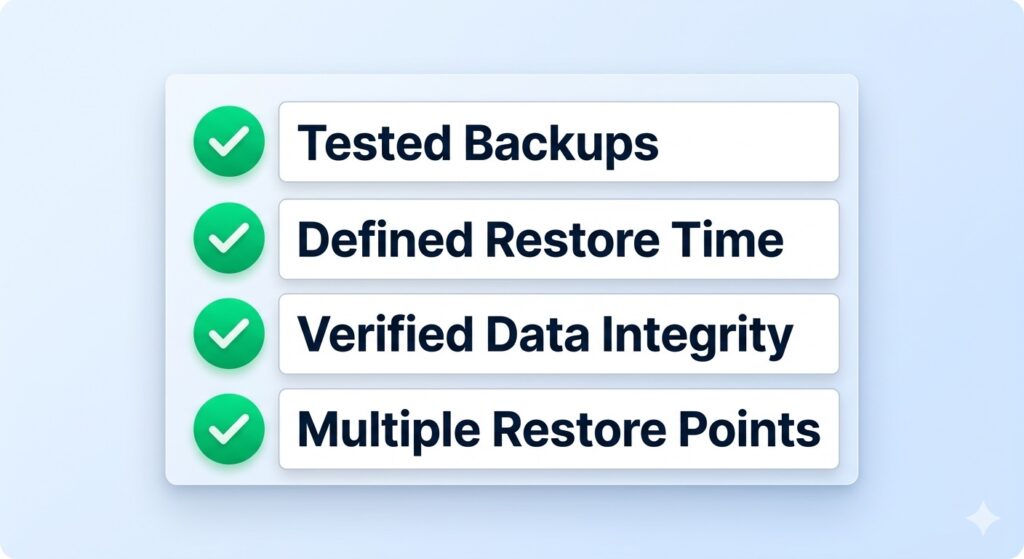
Use these key questions to evaluate if your organization is truly prepared for an incident.
- Do you know how long it would take to restore your critical systems?
- Have your backups been tested to confirm they can be fully restored?
- Can you recover clean, uncorrupted data, not just any version of it?
- Do you have multiple restore points available if the latest backup fails?
- Is your recovery process clearly defined, or dependent on trial and error?
What Recovery Readiness actually means
Recovery readiness is not about storing more data; it is about being able to restore the right data at the right time, without delays or uncertainty.
This includes:
- Validated backups
- Tested restore processes
- Confidence that the data is complete and usable
Organizations that focus on recovery readiness can respond quickly and resume operations with minimal disruption.
Don’t wait to find out your Backups don’t work
Most nonprofits only discover recovery gaps during an actual incident, when systems are already down, and time is critical. At that point, recovery becomes slower, more expensive, and less predictable.
The better approach is to identify those gaps before they impact your operations.
To evaluate your recovery readiness and reduce the risk of downtime, explore nonprofit data protection solutions or validate whether your backups can actually be restored through backup verification and recovery
Central Data Storage (CDS) focuses on recovery-first data protection; ensuring your organization can restore systems quickly, with clean and verified data when it matters most.
Non-profit Data Loss FAQs
What is the difference between RTO and RPO for Non-profits?
RTO defines how quickly systems must be restored after data loss, while RPO defines how much data loss is acceptable. Non-profits must set both to ensure recovery meets operational and reporting needs.
How much downtime can a non-profit typically afford after data loss?
A Non-profit can afford only limited downtime, as delays affect fundraising, communication, and services. Even a few hours of disruption can impact donor trust and operational continuity.
What should non-profits look for in a data recovery provider?
A Non-profit should look for verified recovery, restore testing, clean data validation, fast response time, and clear recovery processes. These factors ensure data can be restored accurately and quickly.
How does cloud storage differ from a true backup system?
Cloud storage saves files for access, while backup systems create recoverable copies with version control. Backup ensures data can be restored after deletion, corruption, or ransomware incidents.
What are the early warning signs that your non-profit’s backup system may fail?
Early signs include missing backup reports, failed or incomplete backups, slow restore times, and a lack of testing. These indicators suggest the system may not recover data when needed.

Ed Conklin is a cybersecurity executive with deep experience in ransomware, cyber risk, and enterprise security strategy. He helps organizations – especially in the healthcare industry – understand how modern attacks impact systems and why recovery readiness matters as much as prevention. His insights focus on ensuring safe, reliable recovery after incidents, including approaches like verified backup recovery and resilient healthcare data protection strategies.
Last updated on April 8, 2026