Healthcare providers should test backup restores at least quarterly, with monthly restore validation recommended for most medical and dental environments. High-risk organizations such as hospitals or multi-site groups should conduct monthly restore testing and at least one full disaster simulation annually.
Backup frequency alone does not ensure recoverability. Restore testing verifies that clinical systems, patient data, and operational platforms can return to production safely and within acceptable downtime thresholds.
TL;DR: Backup Restore Testing Frequency in Healthcare
- Healthcare providers should test backup restores monthly, with quarterly full-system validation and annual disaster simulations.
- A “backup successful” alert does not guarantee clean or functional recovery.
- Incremental backup chains and ransomware exposure increase restore failure risk.
- Restore testing must validate EHR startup, database integrity, dependencies, and recovery time.
- Backup monitoring confirms data exists; restore testing confirms systems operate.
- Unison Lite, Unison BDR, and Unison Complete support structured, environment-specific restore validation.
- A Healthcare Data Risk & Recovery Assessment helps align restore cadence with operational and ransomware risk.
Restore testing protects patient care — not just data.
This validation framework aligns with CDS’s approach to backup verification and recovery, where restores are proven — not assumed.
Recommended Restore Testing Cadence for Healthcare Providers
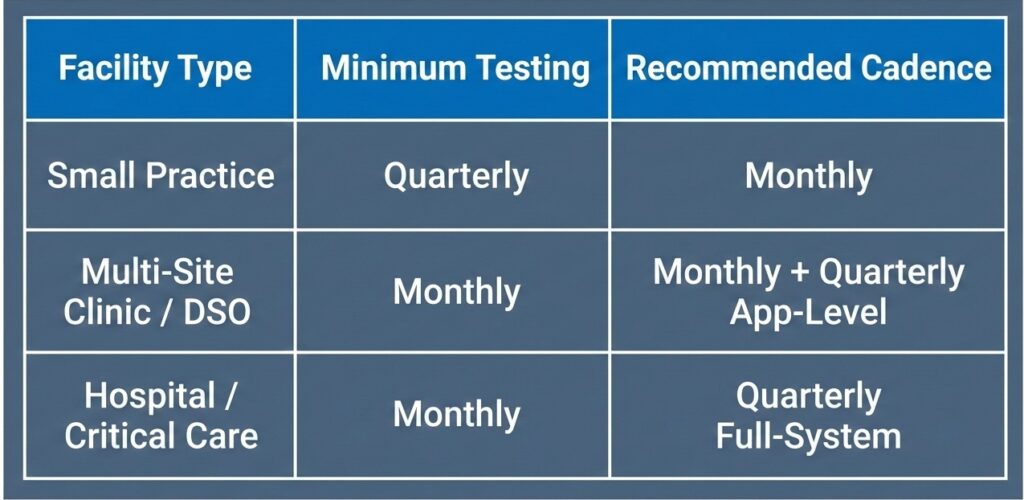
Choosing the right testing frequency based on organizational complexity.
Why Monthly Restore Testing Reduces Healthcare Recovery Risk
Healthcare environments are high-change systems:
- EHR updates and patches
- Infrastructure changes
- Security configuration updates
- Incremental backup chain growth
Quarterly testing may meet a minimum standard, but monthly validation significantly reduces restore uncertainty.
UnisonBDR v2.1.9
Automated Scheduled Test Restores Now Available
With the release of UnisonBDR v2.1.9, CDS introduces automated scheduled Test Restores — allowing restore tests to run automatically on a defined schedule instead of relying on manual execution.
- Automated Execution: Set recurring restore validation automatically to keep recovery readiness consistent without manual overhead.
- Test Restore Certificate: Receive documented, audit-ready proof after each completed restore test for internal reviews, HIPAA compliance preparation, and recovery verification.
Platforms such as Unison Secure, Unison BDR, and Unison Complete support structured restore validation workflows — but cadence must be defined operationally, not assumed.
Backup Monitoring vs Restore Testing: Key Differences in Healthcare Recovery
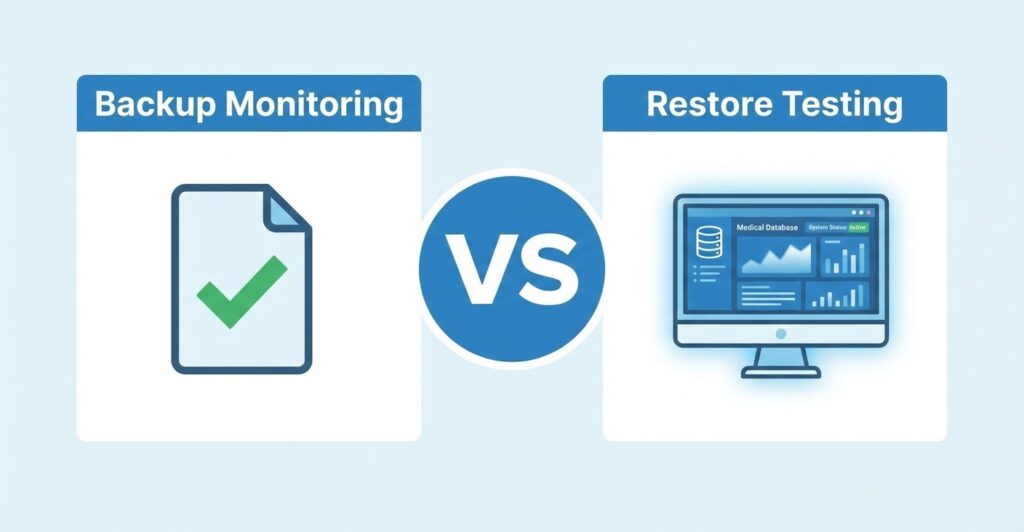
Monitoring confirms the data exists; testing confirms the data actually works.
Backup monitoring confirms that a backup job ran successfully.
Restore testing confirms that systems can operate after recovery.
These are not interchangeable.
What Backup Monitoring Validates
Backup monitoring typically verifies:
- Job completion status
- Storage destination availability
- Backup file creation
- Error reporting during execution
Monitoring answers:
“Was data written?”
It does not answer:
“Can the system function after restore?”
What Restore Testing Validates
Restore testing confirms:
- EHR platform startup
- Database integrity after reassembly
- Application dependencies
- User access functionality
- Measured Recovery Time Objective (RTO)
Restore testing answers:
“Can patient care systems return to operation safely and within acceptable downtime?”
Backup completion confirms a job ran.
Restore testing confirms the system works.
This distinction becomes clearer when examining why a “backup successful” alert can still result in operational failure.
Why “Backup Successful” Does Not Guarantee Healthcare Recoverability?
A backup job status confirms that data was written to storage. It does not confirm that clinical systems, databases, or applications will function after restoration.
Restore testing verifies operational recoverability.
In healthcare environments, restore failure typically surfaces only when systems are brought back online. Common causes include:
- Database inconsistencies inside EHR platforms
- Broken incremental backup chains
- Missing application dependencies
- Restore points created after security compromise
A backup can complete successfully while still failing at the application level. This operational gap is examined in detail in Why Backup Success Fails Healthcare.
Restore testing reduces this uncertainty by validating:
- Application startup
- Database integrity
- Dependency resolution
- Measured recovery time
The next step is defining restore cadence by healthcare environment.
Restore Testing Frequency by Healthcare Environment Type
Restoring testing cadence should reflect system complexity, patient volume, and operational impact. A single schedule does not fit every healthcare environment.
Restore Testing for Small Medical and Dental Practices
Smaller practices typically operate:
- One primary EHR platform
- Limited on-site infrastructure
- Fewer integrated applications
Recommended cadence:
- Quarterly minimum restore testing
- Monthly validation preferred
- Immediate testing after EHR upgrades or infrastructure changes
Monthly testing reduces risk created by incremental backup chains and frequent software updates.
These environments often rely on structured healthcare data backup architecture to support application-level restore validation without enterprise-scale complexity.
Platforms such as Unison Lite support structured restore validation for smaller environments without requiring enterprise-scale infrastructure.
Restore Testing for Multi-Site Clinics and DSOs
Distributed environments introduce:
- Shared databases across locations
- Remote access dependencies
- Higher change frequency
- Increased ransomware exposure surface
Recommended cadence:
- Monthly restore testing
- Quarterly application-level validation
- Annual full-environment simulation
Testing should confirm that restores function across site dependencies — not just at a single location.
Coordinated restore validation is typically supported by backup and disaster recovery software designed for distributed healthcare systems.
Restore Testing for Hospitals and Critical Care Facilities
Hospitals operate:
- Complex EHR ecosystems
- PACS and imaging integrations
- High transaction volumes
- Continuous uptime expectations
Restore testing must be more frequent and more comprehensive.
Recommended cadence:
- Monthly restore validation
- Quarterly full-system recovery testing
- Annual disaster simulation
- Measured Recovery Time Objective (RTO) during each test
In higher-risk environments, restore testing should validate not only data integrity but operational readiness.
A structured cyber backup and recovery platform integrates restore validation with cybersecurity oversight to reduce contaminated recovery risk in high-complexity systems.
Restore frequency must align with system complexity and exposure level — not just compliance minimums.
Backup structure also affects cadence requirements. Incremental backup chains, in particular, may require more frequent validation.
Do Incremental Backups Require More Frequent Restore Testing in Healthcare?
Yes. Environments that rely on incremental backups typically require more frequent restore validation.
Why Incremental Backup Chains Increase Restore Failure Risk?

Why incremental dependencies require monthly validation to ensure integrity.
Incremental backups store only changes made since the previous backup. Over time, this creates a dependency chain:
- Full backup
- Incremental segment 1
- Incremental segment 2
- Incremental segment 3
- … and so on
To restore the most recent state, the entire chain must function correctly.
If one segment is corrupted or missing, the restore may fail — even if the latest backup completed successfully.
Restore Testing Implications for Healthcare Providers
Healthcare systems often:
- Update EHR platforms frequently
- Process high transaction volumes
- Maintain longer retention windows
- Add integrations over time
These factors increase chain complexity. Restore testing must validate:
- Entire incremental chains
- Application-level functionality
- Database consistency after reassembly
If your environment relies primarily on incremental backups:
- Shift from quarterly to monthly restore testing
- Validate full application startup — not just file extraction
- Measure restore time, not just completion
Restore validation confirms that incremental dependencies remain intact and usable.
Incremental backup risk becomes more significant in environments exposed to ransomware activity.
- Entire incremental chains
- Application-level functionality
- Database consistency after reassembly
If your environment relies primarily on incremental backups:
- Shift from quarterly to monthly restore testing
- Validate full application startup — not just file extraction
- Measure restore time, not just completion
Restore validation confirms that incremental dependencies remain intact and usable.
Incremental backup risk becomes more significant in environments exposed to ransomware
activity.
How Ransomware Risk Changes Restore Testing Frequency?
Ransomware increases restore risk because backup systems are often targeted before encryption is triggered.
Modern attacks frequently include:
- Credential harvesting
- Privilege escalation
- Backup system access
- Delayed encryption activation
During this dwell time, compromised data may already be included in backup chains.
If restore testing is infrequent:
- Contaminated restore points may remain undetected
- Backup chains may include encrypted payloads
- Restored systems may reintroduce infection
Restore validation must confirm not only functionality but integrity.
Healthcare environments exposed to elevated ransomware risk should:
- Test restores monthly at minimum
- Validate clean restore points before production recovery
- Confirm system functionality in an isolated environment
Restore testing in ransomware-prone environments should verify:
- Application startup without anomalies
- Database accessibility
- No unexpected encryption artifacts
- Acceptable recovery time
Solutions such as Unison Complete include pre-restore integrity validation to reduce contaminated recovery risk in high-exposure systems.
Restoring cadence must reflect exposure level.
Final Recommended Restore Testing Schedule for Healthcare Providers
Restore testing cadence should be predictable, documented, and aligned with operational complexity.
How to Apply the Restore Testing Schedule
Small Practices
- Validate EHR startup and database integrity
- Confirm scheduling and billing functionality
- Measure restore time during testing
Multi-Site Environments
- Test restore consistency across locations
- Validate shared database dependencies
- Confirm remote access integrity
Hospitals and High-Complexity Systems
- Validate full-system operational readiness
- Measure Recovery Time Objective (RTO)
- Conduct controlled disaster simulations annually
When Healthcare Providers Should Increase Restore Testing Frequency?
Increase cadence if:
- Infrastructure changes occur
- EHR upgrades are deployed
- Backup architecture changes
- Ransomware exposure increases
- Incremental chains grow significantly
Restore testing frequency should adjust to risk and complexity — not remain static.
Healthcare providers should not rely solely on minimum thresholds. Monthly restore validation is appropriate for most environments, particularly those handling continuous patient care operations.
How CDS Platforms Support Structured Restore Testing in Healthcare?
Restore testing must be repeatable and documented at the application level. CDS supports this through a tiered healthcare-focused platform model.
Unison Lite for Small Healthcare Practices
Supports:
- Scheduled restore validation
- Application-level startup testing
- Recovery time documentation
Designed for smaller medical and dental practices.
Unison BDR for Multi-Site Healthcare Environments
Supports:
- Coordinated restore validation across sites
- Backup chain integrity verification
- Centralized restore documentation
Designed for multi-site clinics and distributed healthcare groups.
Unison BDR for Multi-Site Healthcare Environments
Supports:
- Restore validation with cybersecurity oversight
- Pre-restore integrity screening
- Clean restore confirmation before production return
Designed for hospitals and high-risk environments.
Healthcare Data Risk Assessment for Restore Testing Validation
If you are unsure whether your restore testing cadence is sufficient, CDS offers a structured Healthcare Data Risk Assessment to evaluate:
- Current restore testing frequency
- Backup chain complexity
- Ransomware exposure level
- Documentation readiness
Restore testing should not rely on assumptions or job-status alerts. It should be validated, measured, and aligned with operational risk.
Request a Healthcare Data Risk Assessment to evaluate your restore testing schedule.
Final Recommendation: Restore Testing Standards for Healthcare Providers
Healthcare providers should not ask:
“Are backups running?”
They should ask:
“Have we proven we can restore cleanly and operate?”
Minimum standard: Quarterly restore testing
Operational best practice: Monthly restore validation
High-risk environments: Structured, documented, multi-layer restore verification
Restore testing is not an IT checkbox.
It is clinical continuity insurance.
Healthcare Test Backup Restores Frequency FAQs
How long should a healthcare restore test take?
Restore tests should complete within the organization’s defined Recovery Time Objective (RTO). Small practices often target 1–4 hours, while hospitals may require under 60–120 minutes for critical systems to maintain patient care continuity.
Should healthcare providers test cloud and on-prem backups differently?
Healthcare providers should test cloud and on-prem backups using the same application-level validation process. The storage location changes, but restore integrity, database functionality, and RTO verification requirements remain identical.
Who should be responsible for healthcare restore testing?
Healthcare restore testing should be owned by IT leadership and documented by compliance officers. Technical teams validate system functionality, while leadership ensures frequency aligns with operational risk and HIPAA expectations.
What documentation is required after a restore test in healthcare?
Healthcare providers should document restore date, systems tested, validation results, recovery time, and corrective actions. Proper documentation demonstrates operational readiness and supports audit and compliance review processes.
Can restore testing disrupt live healthcare systems?
Restore testing should not disrupt production systems when performed in isolated environments. Healthcare providers should use sandbox or segmented recovery environments to validate functionality without affecting patient care operations.